
Much More Than a Runner
A Q&A with multi-sport adventurer, FKT pioneer, and podcaster Buzz Burrell
Welcome back. Occasionally, I spotlight other runners—usually older ones who give me hope as I age that my body can keep running and playing in the outdoors—and today is one of those times. I’m eager to share a conversation with a multi-sport adventurer I’ve long viewed as a role model and innovator in ultrarunning.
Reminder: I host a monthly chat and write occasional bonus posts for paid subscribers. If you’d like to support this newsletter and join our online meetup (which this month will be April 25 at 5pm Mountain), please upgrade your subscription to the supporter level. You’ll also receive my deep gratitude!
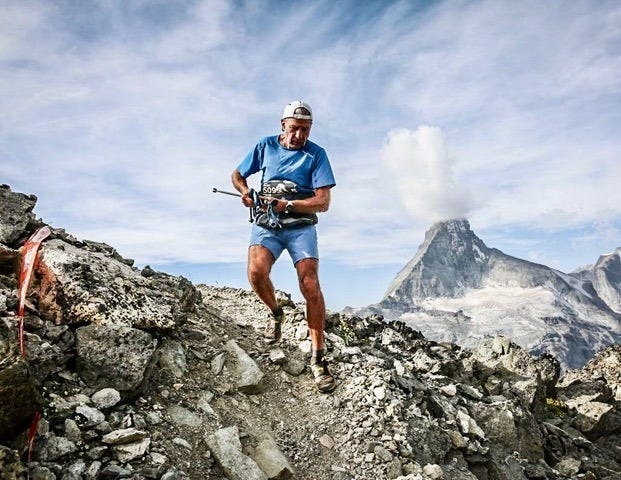
I started paying attention to Buzz Burrell a little over a decade ago, when I was new to running 100-milers and coaching, because he led the company Ultimate Direction that made the hydration pack I wore. He was revered as one of the pioneers of the Fastest Known Time (FKT) movement and co-creator of the website that tracks and verifies FKT attempts, which involves the challenge to do a certain route faster than anyone else.
Back in 1999, he and his adventure partner Peter Bakwin (who later created the fastestknowntime.com site with Buzz) set a record on the 500-mile Colorado Trail, traversing it in less than 12 days by logging ultra-distance days through the San Juan Mountains, long before “FKT”1 became a sub-niche in the niche of ultras. (Check out the list of the 20 FKTs that Buzz holds here.)
Then he did something that really caught my attention and made me wonder, who is this badass old guy who also can write?
His story came to me through the Ultimate Direction blog, to which I used to subscribe. In October of 2014, Buzz, who was 62 then and is 73 now, and two buddies wanted to do a Rim-to-Rim-to-Rim crossing of the Grand Canyon. But they didn’t want to connect the South Rim to North Rim and back via the common crowded route that combines the South Kaibab, North Kaibab, and Bright Angel trails. So they blazed their own route.
The obscure way they chose had one main drawback (or challenge, to their minds): no bridge over the cold, churning Colorado River. No problem—they ran with wetsuits in their packs, put them on at the river bank, and swam the river. They named the route R2R2R.alt. (Story here, told in Buzz’s deadpan-irreverent tone.)
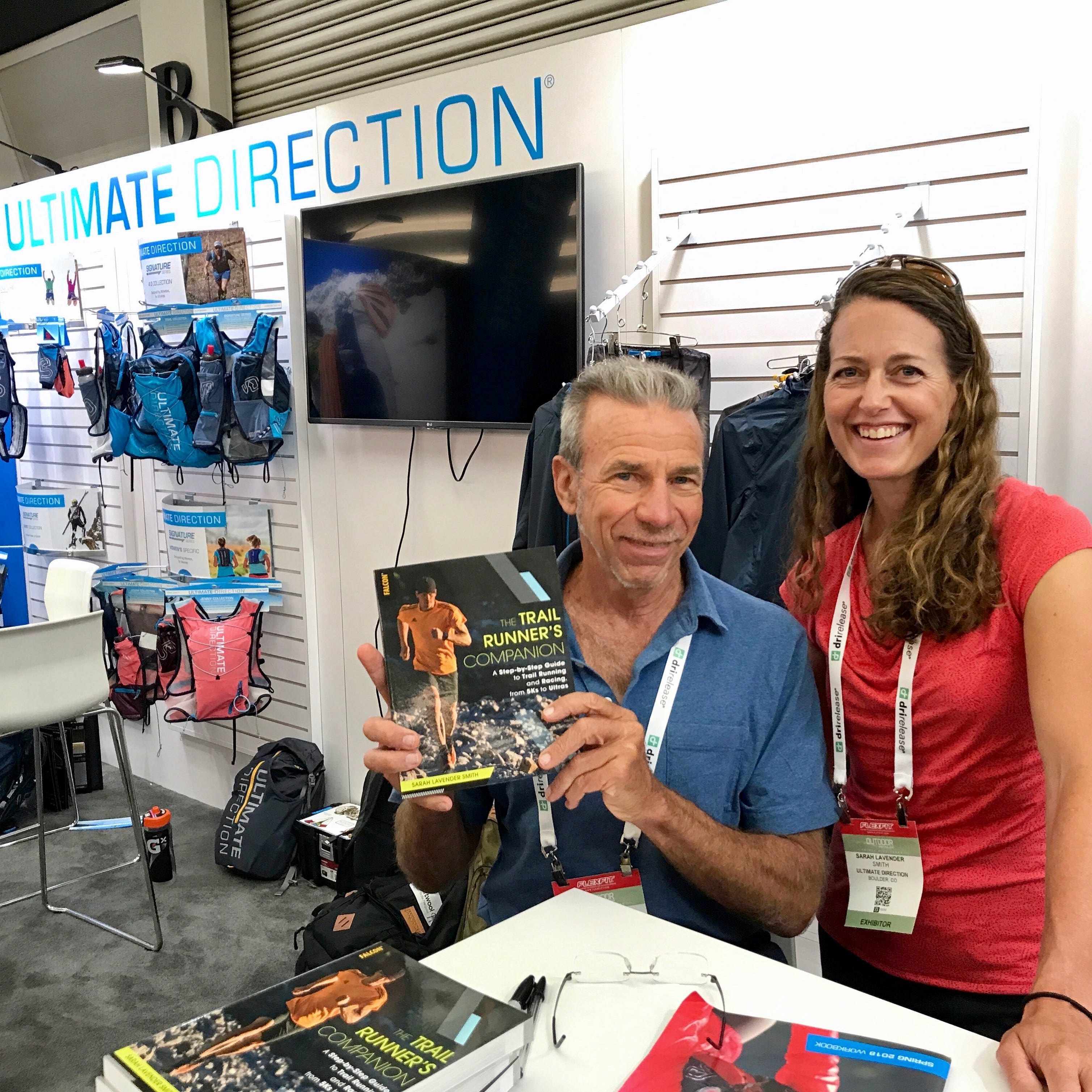
I met Buzz in 2017 at the Outdoor Retailer show when I was promoting my book and then, a couple of times, I crashed the party he annually held in Silverton before the start of Hardrock. I hung back like a fan girl nervous to talk to a rockstar.
More recently, I started listening to The Trailhead podcast he hosted first with co-host Corrine Malcolm, then with Zoë Rom. On their last episode together, he and Zoë announced that Buzz was spinning off to create his own podcast, The Buzz. The first episode of The Buzz features him interviewing “the most influential runner in history,” and their talk contains some fascinating moments in recent history that the newer generation of runners may not know about (you’ll have to listen to learn who the guest is).
This Saturday, I’ll get up close to Buzz again because I’m participating in an event he directs: the Moab Running Up for Air (RUFA) timed ultra, which involves repeat laps up and down a short, steep trail, with 6- and 12-hour divisions. (I’m doing the 6-hour as a training hike to adapt to more vert.) As I’ve written about before, the RUFA series is a collection of timed ultras with laps on very vertical routes that raise money and awareness for clean air and other environmental issues.
It struck me that I wanted to get to know Buzz better and ask him questions, given that both his podcast and his directing of the Moab RUFA seem cool, and his highly active approach to “retirement” is something I’d like to emulate. So I reached out and conducted the following Q&A.
Q: I read that you grew up in Kalamazoo, Michigan, and now you divide your time between Moab, Michigan, and the Alps. But Colorado played a big role in shaping you during your formative years. Can you tell me about your Colorado roots?
Buzz: I attended the University of Colorado from 1969 to ’70, enough time to participate in an anti-Vietnam War march of 8,000 people down Broadway Street and to shut down the university for five days after the Kent State Massacre. It was a dynamic time, including managing the third-largest natural food store in the country. I moved to Paonia in 1973 and founded the first certified organic farm in Colorado, an Organic Growers Cooperative, a natural food store, and a sporting goods store.
Tell us about how you got into running. I also read that you did a Forrest Gump-like run in 1969, when you were 18, from Kalamazoo to Lake Michigan, which is 38 miles.
That’s right. I had no mentors, no examples, nobody I was following. I have no story of “discovering running” or of it “changing my life.” I never smoked, drank, or took drugs, so there was nothing I needed saving from. I ran because I felt like it. Still do. The home-to-water run to Lake Michigan was classic, because I brought no food, water, money, or phone. Just did it in the middle of July and got water from lawn sprinklers.
I enjoy following your Strava to see the different activities you do—from mountain biking, to kayaking and stand-up paddling, to climbing, hiking, and of course running. It seems you’ve always engaged in a mix of mountain-oriented activities and haven’t identified solely or even primarily as a runner. Do you think this variety has helped you with aging and staying healthy in any way?
I don’t self-identify as a runner, let alone an ultrarunner. I’m an adventure athlete. I move in nature by whatever means is most appropriate. There’s “cross-training” and “multi-sport,” and I do the latter, as it indicates numerous sports equally weighted rather than one major sport with associated sports.
However, I worked for La Sportiva [where he created and managed the La Sportiva trail-running team], directed Ultimate Direction, and co-founded Fastest Known Time, so I’m known as a runner. And due to these commercial involvements, I’ve done a lot of it. I’d rather be dancing, but no one wants to pay me to do it.
In one weekend maybe 10 years ago, without trying, I raced a 10K snowshoe, 10K classic (ski), and a 15K skate race in the morning, then a swing dance competition in the evening, then a 13K trail-running race the following morning, then a city league co-ed volleyball competition in the evening.
Multi-sport is very interesting in terms of longevity. As one matures, it helps people like me; when running, I have extremely good strength and balance, which is quite helpful on or off trail. However, past maybe age 50 and certainly at 60, it’s possible this may reverse. The most successful older road runners do almost nothing but the exact same thing day after day. Their body totally adjusts to this one motion, and they become quite efficient. I would rather shoot myself than do that, but I think the “only-one-motion” plan helps the upper age group run efficiently.
Related to the above: What’s your favorite sport or activity these days and why?
I had been doing minimal running for five years, but coming up on 70 I thought, “Heck, let’s see if I can still do it.” The Moab Trail Marathon was one day after my birthday [in November], so I trained up, entered it, had a good time, and went on an ego-gratification bender for a few years, winning my age group (and often the one below) while doing 12 to 16 races per year. I’ve now eased up and am enjoying creating new routes on multi-day treks in the Alps the past few summers.
Oh, and I e-foil [which is surfing on a board with a powered propeller]. It’s sort of embarrassing to say I do this, because it’s obviously dangerous, and it’s not like I don’t have anything else to do. But when I turn it up past 16 miles per hour, the board lifts out of the water, I’m floating on the wing, it becomes silent, and I can’t look too close at the water because I’ll get mesmerized and fall off.
How did you get into podcasting relatively late in life, and how do you like it?
We started the Fastest Known Podcast six years ago, and I hosted that weekly for three years until we sold the business to Outside Media. Then after a year, I pitched a podcast idea to Ultrasignup, and they supported it. I love podcasting. I feel like I’m talking to friends, and the listeners are more friends in the same room with me.
A year ago, UltraRunning published your “Widowmaker” essay about your emergency coronary angioplasty to clear a 95 percent blocked artery. (I highly recommend reading it for the lessons it imparts about cardiac health and getting timely medical care.) Your heart disease diagnosis took you by surprise. Did your cardiac close-call change you in any way in terms of your health maintenance, athleticism, or perspective on life?
Yes. Now is the time. Whatever you want to do or be in life, now is the best time. Maybe the only time.
Mortality is very interesting. We never think about it, which sounds dumb, since it’s obvious we all are going to die. But also very correct, because it is our genetic mandate to live, thrive, and survive, and thinking about anything else is a distraction.
Until one does almost die. Then it can go two ways: (1) “Whoa, life is dangerous, we have to be really careful, take the best care of ourselves possible. Let’s buy an even bigger house and fill it with stuff from our past, because our future isn’t interesting.” Or, (2) “Whoa, life is precious. I’m going to die soon, absolutely no getting around it, so I’m really stimulated to live, grow, experience.”
I feel more motivated now than 20 years ago. Life is a bell-curve—I’m on the way down, and it feels good because downhill is faster and easier! I want to go out the same way I came in: naked with nothing.
Looking ahead to this weekend, why did you bring RUFA to Moab? Moab doesn’t seem to have the kind of air quality problem that other RUFA locations do. What are you hoping to accomplish with RUFA in Moab?
Running Up For Air is an event Jared Campbell created that has become a Western classic! See how many laps you can run up some steep mountain in a set length of time. They are way more social and fun than any other ultra because you’re seeing people all the time. And no huge mess of cars driving all over the countryside—ultra races are mini environmental calamities—because there are no aid stations except for the one at the bottom of the route.
Salt Lake City has some of the worst winter air quality in the world, and I’m glad Jared’s bringing attention to it, but that’s a problem they made. So in Moab, 50 percent of our proceeds go to the local Youth Garden Project, and the other 50 percent to Breathe Utah, which is statewide.
We’re going to have some fun! Unlike the other seven RUFA’s, coming to Moab means no mud, no microspikes, and no headlamps! I strongly encourage people to enter anytime, right up to 6pm Friday before the April 5 event. [Get info and register here.]
Lastly, do you have any advice for a longtime 55-year-old mountain/ultra/trail runner who feels she’s so much older and slower than when she ran her PRs that she wonders if she should quit signing up for ultras? What can she do to keep running into her 70s like you?
Attitude is where I always start. You are "so much and slower than when you ran your PR’s”! That is a fact. And it sucks. Sugar-coating reality is stupid—be honest and real with who you are, right now.
And then what? Stopping running makes perfect sense. Running is really hard. And recovering from an injury in middle age (like you have just done) is way harder than the hardest race you've ever done. So if it feels better to stop, just stop.
But if not running doesn’t feel better, then keep going. Suck it up, buttercup. Old age is not for sissies. Because you are not “only as old as you think you are”—that is scientific BS if not insulting—because biological aging is very real with a very well known final outcome (death).
Ultras are hard. They take a long time. I’m not sure how fun they are. For me, around 30K is the sweet distance: I go really hard, jump over logs, hurdle streams, chase down other runners on the technical descents, and I don’t get sick or get blisters, and afterwards I feel good and excited! But whatever floats your boat.
Health is the key for aging runners. Training plans are good but secondary to being healthy overall. Eating and sleeping patterns are crucial; you have to be strong and healthy enough to do the training at all.
And training has to include two things: (1) strength work. This is so under-appreciated among ultrarunners. And (2) consistency. Keep going; do not ever take more than two weeks completely off from exercise. Lay the foundation one brick at a time. And everyone needs to do a solid tempo run once a week, no matter their chosen distance.
So here we are, and if you feel you were born to run, then keep going. Know it will be hard, know you are essentially managing a long slow retreat, and yet, it will still be rewarding! It’s much easier if you realize you don’t have that much choice; you’re just manifesting who you are.
Thank you, Buzz, for your words of wisdom on aging and adventure!

Recommended reading:
Three newsletter posts hit hard in a good way this week:
Scott Dunlap’s description of emergency eye surgery for sudden vision loss while running. Scott is the best-known and original trail-running blogger, and I’ve crossed paths with him and interviewed him for various stories over the past two decades. This one moved me emotionally big time and is beautifully written.
Jill Homer’s jaw-dropping race report from the White Mountains 100 in Alaska.
Callum Jones retelling Switzer’s 1967 Boston Marathon story (always worth retelling), which transitions to a story about a women’s-running support network and the reality that many experience a kind of imposter syndrome as runners.
“FKT” is pronounced F-K-T, not squashed together liked “f*cked.”
Wow, thank you for taking the time to write a good story. Like everyone else, I feel like a schlub, so reading this gives me encouragement to stop binge-watching re-runs of "I Love Lucy" and instead get out the door.
You are a real writer. I appreciate that; it's an honorable profession and there are not as many of you as there used to be. You are kind, thoughtful, and introspective; thank you for doing what you do.
This is a great interview, thanks Sarah. I’m probably not going to do an FKT any time soon but it’s got me thinking about what the next big challenge can be - and how it doesn’t have to be running!