
Life After Running?
A book review on how to handle the transition away from running—if you have to—plus other updates
Hi there—I’m not sure why, but I had a significant uptick in subscribers over the last week or so. If you’re new here, welcome and thank you! You can learn more about me on my website. Today I bring you a book review plus various links. I’m tapering for an ultra Saturday—the Quad Rock 50 in Fort Collins—and will return next week with a race report.
A book you might not want to read but should
Countless nonfiction books have detailed how to develop as a runner. But as far as I can tell, none has focused on how to cope with the end of one’s running years when running no longer serves the body well or no longer is possible. A new book fills that gap in the running-lit niche.
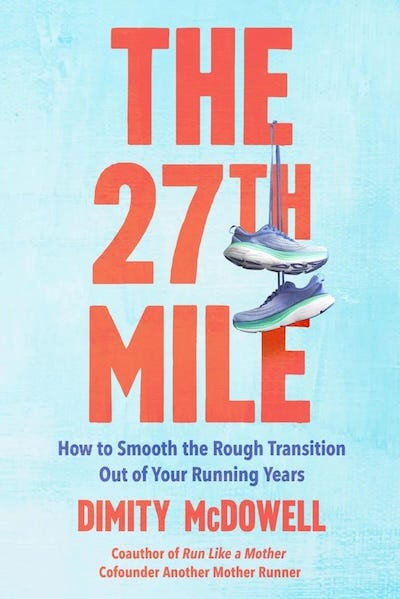
Dimity McDowell’s The 27th Mile: How to Smooth the Rough Transition Out of Your Running Years primarily is for runners who are struggling to run or no longer can run due to chronic injury, illness, and/or psychological factors such as persistent burnout or stress. But it’s useful for injured runners as well as retiring ones.
You might wonder, as did I, is there really a whole book’s worth of material to explore about the end stage of one’s running? Yes, it turns out, there is!
Even if you don’t want to “go there” mentally to consider a future date when you can’t run, I recommend you do, because our running years likely do have an end point. And, you might cope with a run-stopping injury eventually.
I am not the target audience—I’m happily running long distances (mostly) pain free, hallelujah, and I plan to keep at it for another quarter century if possible—but I discovered loads of helpful advice about leading a more balanced athletic life, supporting one’s injured runner friends, and examining my identity as a runner. I wish I had been able to read it when I suffered three months of blues and uncertainty from my torn-tendon injury in late 2024-early ‘25.
You may recognize the author’s name as the co-founder of Another Mother Runner community and podcast, and as a sportswriter for magazines including Runner’s World. I enjoyed getting to know McDowell better through this book; in fact, her first-person sections were my favorite passages.
She sets a warm and funny tone with an unexpected opening line—”As the author, I shouldn’t say this, but I’m sorry you picked up this book”—and begins by sharing her long battle to be the runner she wanted to be in spite of her extra-tall (almost 6’4”) body that kept breaking or rebelling from foot to hamstring to lower back. For every good day she ran and every marathon or half-marathon finish line she crossed, from the mid-1990s to 2020, she experienced not-so-satisfying or downright frustrating days when she either did not run due to pain, ran cautiously while recovering from an injury, or cross-trained and did PT to manage her injury-prone areas.
“Anybody who isn’t a runner might ask, why? Why spend so much time, money, and effort loving a sport that clearly didn’t love you back?”
We runners get it. We know the reason is because running feels so good when it does feel good, mentally as well as physically, and improves so many aspects of life. In a sidebar at the end of Chapter 3, she includes an alphabetized list of the things she misses about running—a litany of why we love to run—to which I related and you probably will too.
She surveyed some 60 women who are former runners, along with a good number of experts in the fields of sports psychology, coaching and training, and physical therapy. With their input and case studies, she wrote sections that cover:
how to decide whether and when to stop running for good, and the stages involved with reaching that decision
how to process the grief from letting go of your routine and your identity as a runner (including writing your own running obituary—and she provides a great personal example)
how to shift and expand your identity as a runner to an athlete in other realms, and develop new interests and friendships—the phase of the metaphorical 27th mile
how to manage runner-friendships when you can’t run, and how to stay involved with the running community as a non-runner if you choose to do so
how to love and accept your body as is, especially as you age and if you put on weight
I’m a former long-distance running coach who still informally advises some peers on running. Reading her examples, I experienced a pang of remorse as I realized that I should be more empathetic and accepting of fellow runners who are injured and who decide to move on from the sport to develop other endeavors, such as cycling, golf, or “just” hiking. I always tell them, “Don’t give up!” and advise them to get second or third opinions and try multiple modalities to heal, as if I’m scolding as much as encouraging. I should trust and support them more to do what’s right for them.
My only overarching criticism is that The 27th Mile relies on all-female examples and therefore limits itself to women. In my mind, this book should be for all and any genders; aside from the well-written passage on menopause, I don’t see why it’s female-specific. I can think of at least two older male runners in this subscriber group—one who’s recovering from back surgery, another from meniscus surgery, both of them uncertain about their return to running—who might benefit from it.
I messaged McDowell to ask about her choice, and I appreciated her candid reply. She wrote, “When I sent out the survey (which went mostly to Another Mother Runner athletes), I heard from just one male runner. I talked to my editor about if she thought I should try to find more, and she said she didn’t think so, so I didn’t ... In hindsight, I wish I would’ve had at least one section about men because this book has definitely resonated with the ones I’ve heard from. If there are any former male runners you’d like to send my way, I’d love to include them in a future post/story.” Emphasis added—men, if you fit that category of a former or retiring runner and would like to share your experience, you could comment below or reply to me by email.
I hope you don’t need this book, but I also suggest you read it just in case. Meanwhile, for an introduction to the author and the topic, I recommend this podcast interview with Dimity McDowell on the Emerging Form podcast with Christie Aschwanden and Rosemerry Wahtola Trommer. I loved their interesting and emotional conversation.
Thoughts, updates & links
Are you as blown away as I am by the Cocodona 250 athletes—especially Rachel Entrekin—and the media coverage? Are you trying not to get too sucked into the addictive livestream? Or do you perhaps have no clue what I’m talking about? Please comment below on what has been most captivating and exciting to you about it so far—or, alternatively, why you might not be paying attention to it.
Cocodona is put on by Aravaipa Running, which just expanded (again!) by acquiring three incredible ultras: Zion, Bryce, and Antelope Canyon—three races founded by ultrarunner and environmentalist Matt Gunn, a storied character who took his life in 2020. For several years, these races were managed by Vacation Races, which I personally felt was a profit-oriented race-directing outfit not very connected to the core of ultrarunning. I’m therefore pleased that they’ll be under Aravaipa’s big tent—as long as Aravaipa, under Jamil Coury, can keep delivering its well-run events, which so far it has. I wrote about Jamil and Aravaipa recently and suspected when we talked that he was eyeing these events. Registration just opened for the March 6 Antelope Canyon, and I’m strongly considering returning to experience those gorgeous slot canyons and Horseshoe Bend again. Past race report on it:

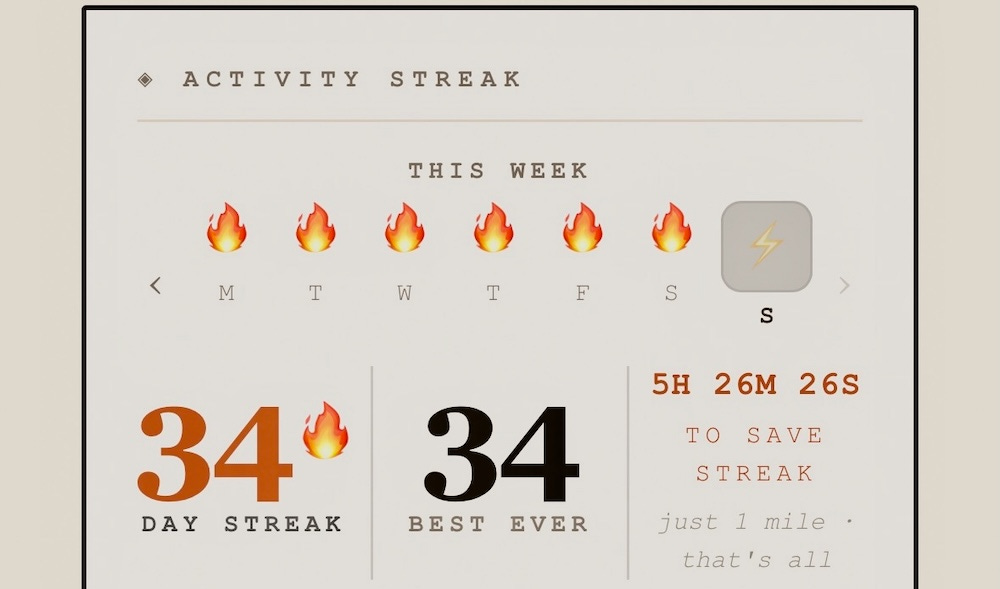
Speaking of Jamil Coury, I got on his run-streak challenge (as detailed in this post a couple of weeks ago). I broke the streak on Sunday, after 34 days, for a couple of reasons. One, I felt in my bones that I needed a rest—my legs felt leaden walking up the stairs in our house—and I wanted to run well the next day on fresher legs and enter a taper week better rested. Two, I wanted to break the streak so I didn’t become obsessive about it. The longer you go, I believe, the more you feel compelled to maintain it. I got what I wanted out of it: a month of consistent back-to-back running with enhanced fitness and fatigue resistance from adapting to running on tired legs. I recommend a streak during a training build—as long as you’re not coping with illness or injury—to enhance consistency and adapt to higher volume. But a month or so is enough.
Three fascinating pieces I read this past week and recommend:
“The Case for Public Tracks” by Sam Robinson on the history and need for recreation spaces open to all
“The Boomers Are Fucking Up Everything! Or Are They?” by Kim Foster on generational differences, identity and group think, and why blaming boomers isn’t so simple
“The Super Shoe’s Step-by-Step Evolution,” a NY Times piece (gift link) on how we got to the shoes that helped break the 2-hour barrier at the London Marathon
In last week’s post, in which I celebrated the benefits of a retreat for creativity and wellness, I recommended a couple of other all-women retreats related to writing and running. I forgot to also recommend this one by Brendan Leonard, which is coed and takes place June 7 - 12. It’s a writing/storytelling + trail running retreat for all levels, and a couple of spots remain open, so check it out or get on Brendan’s list to learn about future retreats he hosts!
Lastly … it’s my birthday later this week (57 candles!), and I have a birthday wish: please consider a donation to my fundraiser.
Last year, as president of our local Rotary Club, I created the community-wide Telluride Rotary Hikeathon, which involves hiking for four weeks in June to raise money for Telluride Rotary and other nonprofits. It was a success, with 80+ participants and $26K+ raised, and we’re doing it again! This year, I plan to hike/run 200 miles in June to support both Telluride Rotary—which uses the funds to host an international youth exchange program, for scholarships to college-bound graduating seniors, and for community service projects—and to support True North Youth Program, where I’m a board member. True North serves teens in our region with academic tutoring, college counseling, outdoor education outings, scholarships, and afterschool programs.
Please consider a per-mile pledge or a flat donation—donations of any size are greatly appreciated! You can give through my fundraising page here. Thank you!
Thanks for linking this book - picking up a copy! (Even though I’m still running but I’m sure that day will come!)
The book sounds interesting. I catch myself writing about running as if it's accessible to everyone, and of course it isn't. Might have to give this a read. Thank you! And Happy Birthday!