
Ready, Set, Plan
How to organize your training for the new year, plus ultra inspiration
Happy new year! Last week, I wrote a bonus post for paid subscribers about cheer and fear during the holiday, plus a story on how I fell for an AI fake. If you’d like to receive occasional bonus posts plus an invitation to the monthly meetup on Zoom—and my deep gratitude for your support—please consider upgrading your subscription.
For new year’s eve and day, I have a double-header for you: this running-oriented new-year advice post today, then a deeply personal story and commentary for tomorrow. I had floated the idea of starting a separate branch of this newsletter for unfiltered personal stories that have less to do with the “mountain running & living” theme and more to do with personal topics such as aging, relationships, and my hangups. The supportive subscribers on our last Zoom chat told me I should keep it all together under this single newsletter umbrella, because they like the authenticity and vulnerability of the personal stories. (Thank you and bless you for saying that.) So if you don’t want to read tomorrow’s story, that’s fine, I just hope you’ll skip it rather than unsubscribe.
Let’s get to it and enter 2026 ready to hit our stride literally and metaphorically.
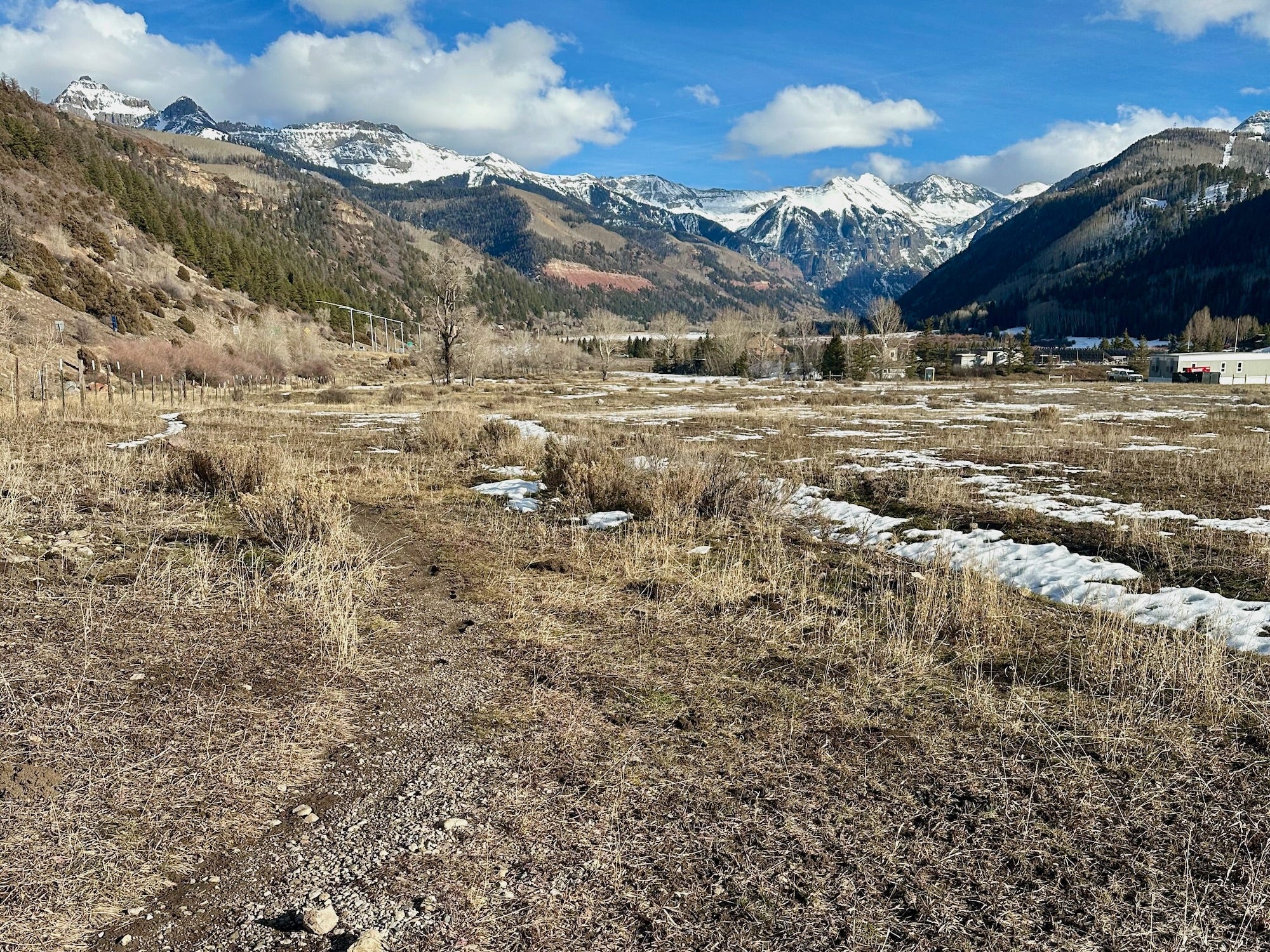
Times are tough in our town due the ski resort’s shutdown, which made national news, caused by the lunatic resort owner who’d rather stiff the striking ski patrollers than pay a reasonable raise. The resort and the local economy are losing many times more in just a few days than what the striking patrollers are asking for over three years. It makes no sense. But the strike is a distraction from the deeper problem: lack of snow. We’re in a dry weather pattern that shows hardly any sign of breaking; every little tease of a storm that enters the forecast gets downgraded to a mere coating to an inch. The sky is a brilliant blue, but almost everyone’s temperament is gloomy.
Not to sound too insensitive, but I’m trying to make the most of it by enjoying family time and seizing the opportunity to run trails that normally would be covered. I’m feeling good physically—no injury!—which I don’t take for granted, since a year ago I started 2025 hobbling from a tendon tear.
I’m also planning my training, because I’m a planner. Are you?
Whether you plan and self-coach, or whether you run by feel or defer to a coach’s training plan, I recommend two articles that will help you develop a big-picture view of your running. Ideally, they’ll enable you to run, work out, and rest with intention. As the legendary coach Jack Daniels, who died last September, used to say: “Know the purpose of every run” and, “rest is part of training.”
The first is one I wrote two years ago, on how to create an annual training plan; the evergreen guidance hasn’t changed.

The other is this recent piece from UltraRunning magazine, “Planning Your Season With Purpose,” by coach Cliff Pittman, and it very much aligns with my coaching and training principles.
The key points of Pittman’s article are:
Identify your purpose and values—the “why” of your running and what you hope to gain from it this year. Personally, my purpose has shifted away from valuing competition toward wanting to explore, adventure, and socialize while maintaining consistency and preventing injury.
Choose A, B, and C races and treat them differently—something I’ve always done, unlike other coaches who believe you should toe a start line only if and when you’re ready and willing to compete with your best effort and give it your all. I view “A” races as the main goals, “B” ones as stepping stones and dress rehearsals in prep for the “A” race, and “C” races are just-for-fun-and-training supported long runs.
Assess your strengths and weaknesses, and work on the weak points—for example, I need to work on my weak and stiff posterior chain of muscles and troubleshoot nausea and sleepiness on overnight efforts.
Train specifically for the demands of the “A” race—as you’ll see from my lineup below, training for the 100-miler San Juan Softie in the high-altitude mountains in August will look different than training for the hot, flatter Javelina Jundred in late October.
Using the planning principles from those articles, I sketched out three main training blocks, or “macrocycles,” for the new year, each with short, purposeful training blocks within them called mesocycles (as explained in the “How to Make an Annual Training Plan” article above).
My macrocycles for 2026
(At least, this is how my plan has taken shape so far. Plans may change, of course.)
January - early May (18 weeks): Build to Quad Rock 50, an “A” race. The Marin Ultra Challenge 50K on March 14 will be a “B” race, and big stepping stone, to the 50M. January will be a mesocycle focusing on rebuilding cardio, strength, and consistency; I’ll de-emphasize the weekend long run so it is not very depleting and prioritize weekday workouts: a speed session and a medium-length hill run as the two high-quality runs during the week, with easy runs and recovery days layered between them, and I’ll do strength and mobility three times/week. Come February (the next mesocycle), I’ll shift to prioritize the progressively longer weekend long run and peak with a marathon-length effort around February 20 before tapering for the 50K. After an easy recovery week following the 50K, I’ll have another mesocycle emphasizing higher volume and more specificity to prep by late April for the 50M (leaving time to taper). I’ll reduce the strength work to one to two times a week, and cut back the intensity of the weekly speed session, to shift time and energy to longer, hillier trail runs.
mid-May - mid-August (12 weeks): Following a couple of easy recovery weeks after Quad Rock 50, I’ll shift to high-country training (run/hikes to trails above timberline) in prep for the June 20 San Juan Solstice 50 (if I get in through their lottery; if I don’t, I could do the Bears Ears 50 again on the same day). Given the slow pace of this mountain “running” with a great deal of hiking in the mix, I’ll endeavor to maintain an interval or tempo run once a week to remind my legs how to run with good cadence at a higher intensity. I’ll also build in some back-to-back long mountain outings to improve endurance. I have a specific goal for the SJS50, so I’ll treat it as an “A” race and give it my all. My ulterior motive training for SJS50 is to get in top mountain-running shape for the unlikely but not impossible chance I move off the waitlist and get a spot in Hardrock, two weeks following SJS50.
Assuming I don’t get into Hardrock, I’ll focus during the July mesocycle on training for a newer ultra that I’m excited to attempt: the San Juan Softie, allegedly a somewhat easier, or at least more manageable, 100-miler in the southern San Juan Mountains near Durango. This phase will feature course recon and specific prep such as nighttime running and practicing mid-ultra fueling and hydration.
Late August - October (10 weeks): After a couple of weeks’ recovery from the San Juan Softie, I’ll shift training to look more like it did at the start of the year: more steady running, and more strength/mobility sessions, with less slow-going high-country hike/runs. I’ll also endeavor to get to lower-elevation hot areas in our region for heat adaptation, all in prep for the October 31 Javelina Jundred (if I get a spot in it). In the middle of this mesocycle, I’ll travel to the Eastern Sierra to do the Mammoth Trailfest 50K again (a just-for-fun “C” race) and volunteer at The Mammoth 200—two fatiguing weeks of a lot of time on feet and a two days’ drive both ways, so I will have to build that reality into the Javelina prep.
Come November, I’ll tune up my legs as best I can for a Turkey Trot 5K, but mostly run for fun in an unstructured way during November/December.
How are your training cycles shaping up for 2026? Share in the comments below!
Ultra inspiration for the new year
Recently, I watched these two short documentaries and recommend them (doc films like these are great for treadmill runs!). I love this look at Hardrock through Zach Miller’s run last summer and his tribute to Bill Dooper:
And I admire the ethos expressed in this profile on Tara Dower:
Starting fresh by starting sober
If you’re on the brink of starting a Dry January—or at least hoping and trying to cut back on alcohol consumption because frequent drinking negatively affects your sleep, makes you bloated and brain-foggy, leaves you feeling out of control and remorseful, or for any other reason—I feel for you and applaud you. I recall when abstaining was so hard for me, such as during race-taper weeks when I’d think, “I can’t/shouldn’t/won’t drink on these nights before the race,” and it felt like a monumental internal struggle with a very short-lived benefit that I’d erase following the race by celebrating with beer and wine.
After some five years of Dry Januarys, I’m happy to report it does get easier and can become the new norm.
My new norm is hardly ever drinking, and only beer when I do; I don’t drink at home and have maybe one beer once or twice a month at a restaurant. Around Christmas, when we had visitors who are wine drinkers, I had one glass of champagne and one glass of red wine with them, and my head felt horrible the next day. My watch indicated my sleep was “non-restorative,” and my HRV (a sign of stress) went haywire. That Christmas bit of wine—which in my prior drinking life, when I nightly drank two or three glasses, would’ve been a small blip—reminded me that I can’t drink wine anymore without feeling badly.
In case you missed it, here’s my story from a year ago about the evolution from three-drinks-a-night minimum to choosing NA beer and kombucha. If you feel unhappy about how much you drink, then I hope my story helps you cut back and choose to drink less or none.

A writing update
Two years have passed since I shared in a late December 2023 post:
“I have stories in my head that I need to get out, stories built on memories that I don’t tend to share in my blogging. I would like to dissect and process those memories, and perhaps laugh and cry over them, to better understand where I came from and why I am the way I am. And, I hope these stories will entertain and move the readers, the way others’ memoirs do for me. … What I’m getting at is, I think it’s finally time to develop a memoir.”
Now, I’m some 30,000 words into a full rewrite of it. I drafted some 90,000 words (the equivalent of a 300-page book) from 2024 to early this year and then, mid-year, realized the structure didn’t work at all and I had way too much shit from my past in it. I made the classic mistake of trying to write the story of my life (the “everything that happened” draft) rather than a story from my life. I therefore reframed the outline as a midlife memoir rather than a coming-of-age story and started over, which was painful (to put it mildly) but necessary.
For the coming month of January, I’m taking on a daily writing-streak challenge called “JanYourStory,” with the hope I’ll hit February two-thirds done and finish my second draft by late April. Then I’ll shift focus to revising, querying, and getting on a path to publication. For that reason, after tomorrow’s post, I’ll keep this newsletter coming out every other week through at least January, then endeavor to switch back to a weekly schedule in February.
This newsletter grew 43 percent, from about 3100 subscribers to 4500, this year. Thank you for being here!
And finally: running is about so much more than your mileage total
Your year-end mileage total, which Strava and Training Peaks will calculate and your peers will share on Instagram, may make you feel proud or inadequate. I hope you feel mostly dispassionate about that number and view it as one data point that doesn’t indicate the quality of the runs, only the quantity. Set it aside and choose instead to reflect on the feelings, views, terrain, lessons, and conversation that unfolded with all those miles.
I used to feel my annual totals needed to grow. Now, I’m just grateful the year-end total is somewhat close to what I used to run annually. It indicates I’m still doing this sport with full mobility, still showing up to some ultras, still making time for trails. Hooray!
With that in mind, I appreciated this post by pro runner Jeff Mogavero, who wrote:
“My year was many things, none of which can be neatly summarized in an app’s attempt to present my statistics so I can brag about them to friends and strangers. These totals are sometimes handy, but not worth sharing. They feel useless unless they also capture my love of movement.”
In 2026, may you run (or hike or bike, whatever floats your boat!) more for the feelings, discovery, and health benefits than to hit a weekly target.
I wish you a happy and healthy start to the year!
What a great plan! I am so NOT a planner, but am trying. I did get into my A race at the end of October so will try to do some strategic planning along the way. But I tend to like to jump into things at the last minute, and since I never really have time goals (except avoiding cutoffs...LOL!) it's not that stressful Although I have toyed with the idea of "racing" (for me) a half marathon this year! Did you get into Javelina? That race looks fun for some.... but I DO NOT like crowds, so definitely not my scene....
I don't even know my total miles from '25! I do know it was way over my goal of 2025 km because the last few years I've been setting a fun, super easy goal like that. You can follow me on Strava and see that I'm pretty consistent. Happy New Year!