
Gotta Try New Things
A backcountry adventure in which I learned a lot, including that I suck
Welcome new subscribers! Thank you to all who subscribed after reading my new year’s day post. If you want to learn about my background, I invite you to visit my website and connect on Instagram @sarahrunning. Through January, I’ll publish here every other week (while I prioritize other writing projects this month), and I hope to return to weekly posts here in February.
A few days ago, I published a bonus post for paid subscribers about storytelling. If you’d like to receive occasional bonus posts and an invitation to the monthly Zoom chat, please consider upgrading your subscription to the supporter level.
When’s the last time you did something new that scared you? That made you embarrassed or awkward as a rookie?
I call the difficult, sometimes humiliating process of learning something new “beginner’s suck.” It’s unpleasant, but it’s almost always an effective teacher.
Running rarely challenges me with fear or frustration, and after 30+ years at it, I don’t have much left to learn about the fundamentals. When I run, I progressively develop a familiar fatigue but hardly ever feel scared of hurting myself, messing up, or looking foolish. Running—like my other main sport, horseback riding—feels natural and intuitive. I run and ride with confidence that my body knows what to do. (Unless I’m running above timberline on sketchy terrain in severe weather, then you bet I’m nervous.)
Yesterday, for example, my normally placid white quarter horse, Cobalt, acted agitated from pent-up energy and blowing wind that made the rooftop of the indoor arena creak and groan. The noise repeatedly made Cobalt throw up his head, tuck under his rump, and bolt in an electrified way that would throw a novice rider out of the saddle.
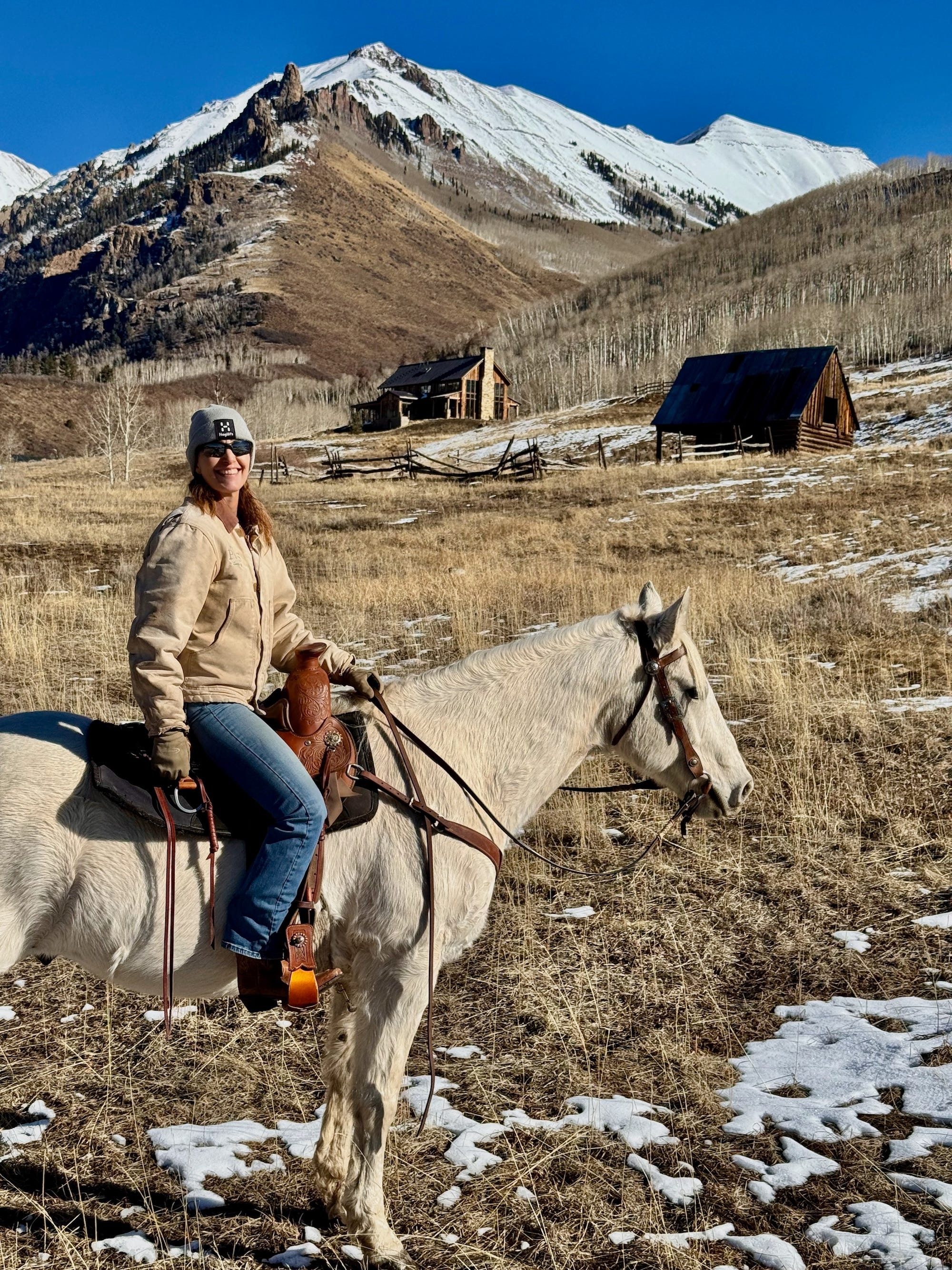
But I found Cobalt’s sudden spooking and galloping amusing, and my heart rate barely changed. My hands and seat automatically adjusted to the sudden acceleration, and my balance never faltered. My skill came from a lifetime of exposure and practice that made the activity second nature.
I share that not to brag but rather to give a contrast to the story that follows—a story of being a beginner, which takes curiosity, courage, and humility. I hope it might prompt you to consider trying a new activity for a not-quite-fun but valuable learning experience.
As parents, we told our kids, “gotta try new things.” I reminded myself of that phrase when I signed up for an ice-climbing workshop a few winters ago, and now I truly enjoy and do well during the occasional ice-climbing day trip. And I repeated it again when I signed up for a different winter adventure last weekend.
Countless times, since moving to the San Juan Mountains a decade ago, I’ve been asked, “Do you backcountry ski?” People assume that as a mountain runner, I’d love the challenge of skiing uphill through forested landscapes, switchbacking up slopes above timberline, and swooshing down through powder.
Problem is, I’m a mediocre skier, because I didn’t grow up doing it and I only halfheartedly took lessons as an adult. I can ski down double-blue and single-black runs only if they’re wide and groomed. Going through narrow tree-lined chutes and navigating moguls is a kind of traumatic test that turns me rigid with risk-aversion and diminishes rather than improves my ski skills because I become frozen with tension and therefore lose balance and fluidity.
Plus, I resist sports that involve a lot of gear and hence love the simplicity of running. Backcountry skiing involves bindings with multiple settings, heavy boots, sticky stick-on skins to put on and peel off the ski’s underside, a helmet and layers of clothing that take constant adjustment, and a whole kit for avalanche rescue because you and/or the person you’re with could be buried alive—let that sink in. So no, I don’t do backcountry skiing.
Yet, it’s ingrained in local wintertime culture. All the cool people around town turn away from the overpriced ski resort and head for the mountains for backcountry ski adventures. My summertime runner friends’ Stravas regularly show “lunch backcountry ski” as if it’s no big deal to zigzag up a couple thousand feet of snow and ski down a mountainside during a lunch break.
Curiosity overruled apprehension—I wanted to see firsthand and try what so many athletes I know do during winters—so I signed my husband Morgan and me up for a beginner backcountry ski session with a guide last Sunday. (I highly recommend hiring a guide for any gear-intensive new adventure; in this area, we use and recommend Mountain Trip.)
This is only a drill
After getting all the rental gear in order, we made our way to nearby Ophir to skin up a canyon that I know well in summertime. We were blessed with calm blue-sky weather, good snow from a recent storm, and relatively minimal avalanche risk.
I followed the guide’s instructions to stick the skins on the bottom of the skis, clipped into the bindings in “walk” mode (meaning my heel could raise), and headed up the snow-covered mountain pass road as if gently gliding in classic Nordic skis. So far, so good.
We had barely covered a mile when the guide told us to detour into a snowy meadow for a rescue drill. Out came our signaling beacons, long probes (which are like folded sticks that extend many feet long), and collapsible shovels. The sobering talk that ensued about avy risk and rescue made me wonder why I had signed up to do this, but also grateful for the information.
The guide wandered off a ways to bury a beacon in the snow, and then Morgan and I had to race—as best we could, which was quite slowly as beginners—to find it by using our beacons near ground level to locate a signal, then a probe to poke through the snow to find the object, then our shovels to dig it out. The beeping of my beacon, like a cardiac monitor, escalated my heart rate, and I flashed back to a gripping podcast I listened to nearly four years ago in which a local runner friend was interviewed about rescuing his friend who had been fully buried on one of the slopes above Ophir where we were headed.
I broke out in a sweat of stress while shoveling during the drill, thinking, this is not my cup of tea. (If you want a sense of what it’s like to trigger an avalanche while skiing or snowboarding in the backcountry, check out this CNN Instagram clip posted Monday.)
After that “interesting” lesson, we headed farther up the mountain pass road and turned off to Chapman Gulch, which is one of the Hardrock Hundred aid stations. I recalled the nadir of my Hardrock last July, when I entered Chapman, which was mile 82, dry-heaving and fully depleted after 35 hours, having lost belief that I could keep going the final 18 miles. Remembering how I got through that 46-hour odyssey restored my faith that I could handle whatever this wintertime outing presented—as long as it wasn’t an avalanche.
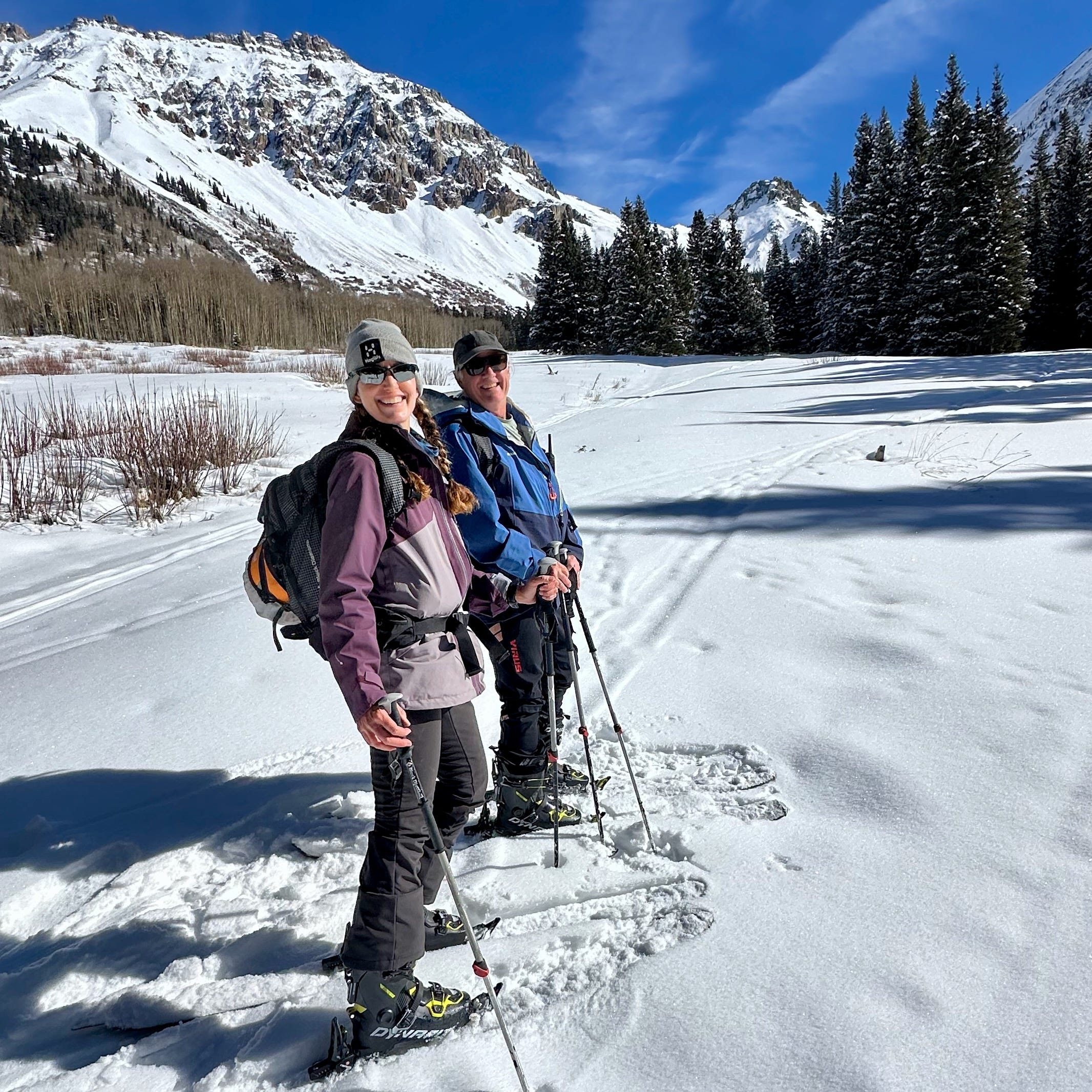
From there, we ascended a picturesque double-wide trail through a pine forest, often stepping to the side as other skiers in the opposite direction swooshed past. I marveled at how they made skiing down that narrow path look easy. Eventually the forest opened to snow-covered slopes.
This was my favorite part—seeing the mountains that I love to traverse in summertime in winter white. I got into a groove methodically skinning uphill.
“I could do this all day,” I said, and our guide replied, “Good, because this is about 90 percent of what we’ll do today, with just one good downhill run, and then we’ll take it slow and easy coming back down this trail.”
At last we came to the base of the slope we’d ascend and ski down. One skier had been there before us and left a perfect pattern of tracks: a pointy-edged zigzag from skinning up bisected by an S-shaped serpentine from skiing down. I had a premonition that I’d royally screw up that beautiful pattern.
This video shows me following the guide on the final pitch:
As we followed the steep zigzag of switchbacks up, the snow grew deeper and I grew uneasy. “You know, I’ve never really skied powder,” I told the guide. On the rare occasion I’ve been to the resort on a fresh-powder day, it’s all cut up, and I tend to follow others’ tracks.
“Really?” He sounded surprised. “Well, this is a good place to try.”
We reached the top and paused to put on helmets and an extra clothing layer, ripped the skins off the bottoms of the skis, and transitioned the bindings to downhill mode. I calmed myself by looking over at Oscar’s Pass—the 13,000-foot pass between Ophir and Telluride on the Hardrock course—where I have run and hiked many times with confidence in contrast to the apprehension I was feeling while staring down the mountain we’d ski.
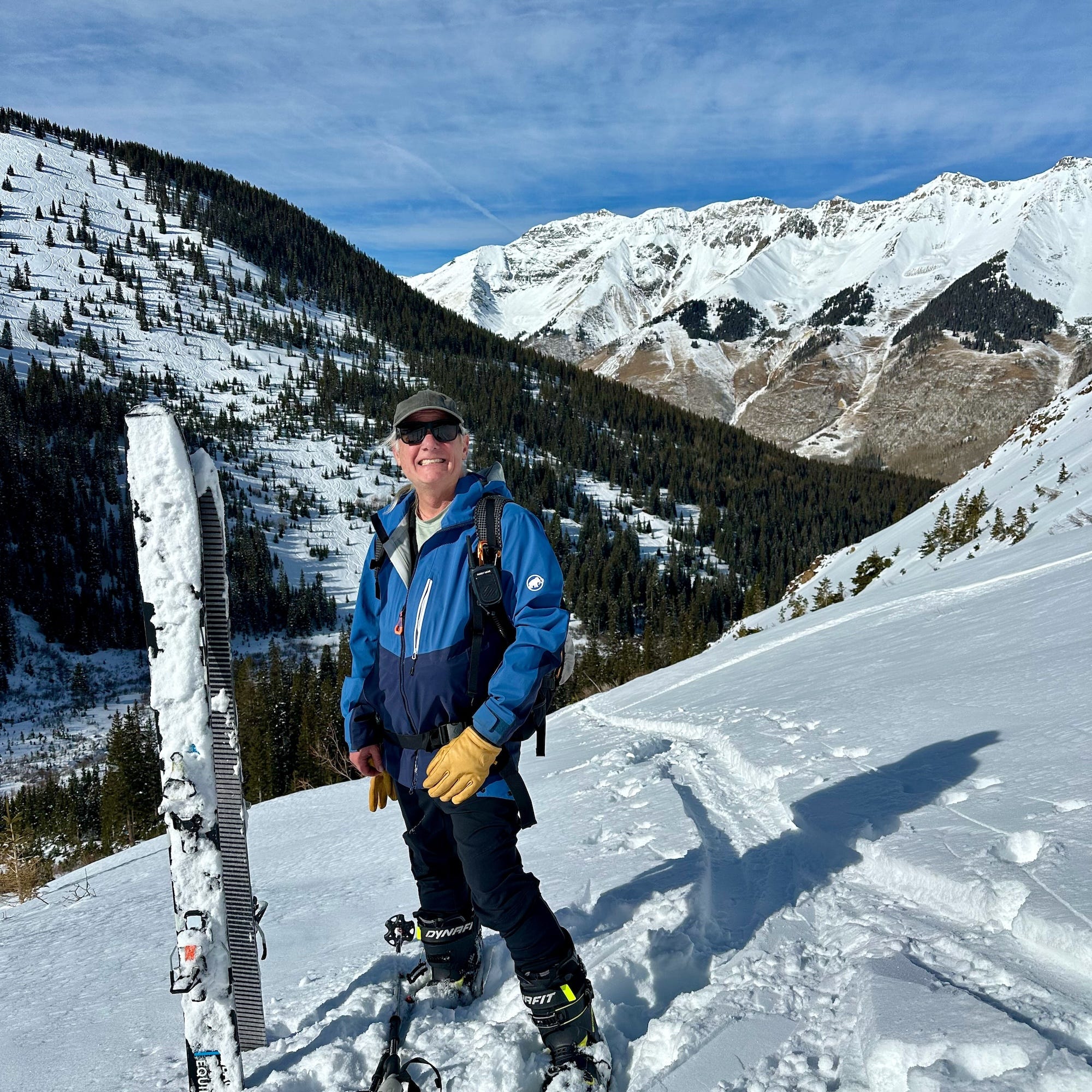
Across the canyon, we spotted numerous ski tracks and an ant-sized trio of skiers trekking up a much more vertical and challenging slope than ours. All the evidence of others’ mastery enhanced my feelings of inadequacy as a newbie.
Finally, after some three hours of uphill work to get to this point, we were ready for our one-and-only ski run. Better make it count.
The guide went first to show us how it’s done, and from the bottom, he signaled to Morgan to go. My husband has been skiing some 45 years since childhood and is as skilled at skiing as I am at running and riding. He feels no fear, and it comes naturally.
I watched and filmed this from above, happy for him and scared for me.
“Whoop!”
I tried to relax and have faith that my downhill skills would come naturally. I do, in fact, know how to ski parallel in a good stance and make tight turns—on a groomed run, that is.
I started skiing, looked down, and saw my boots and skis had disappeared in the powder. Not being able to see my feet freaked me out! That meant I couldn’t see a buried obstacle like a rock, either. Instinctively, I tensed up and wedged my skis for control. With legs wide and body rigid, my turn hit the skids and went belly-down.
Get ready for the two seconds the guide filmed me before he said “whoop!” and automatically put his phone down to make sure I was OK.
That’s right, I face-planted one turn into the run, and to make it worse, my ski popped off. Thankfully, it did not slide down the hill. As the guide and my husband weakly shouted from way below “good job” and “you got this”—both outright lies—I crawled over to the ski and went through the arduous task of reattaching the little pin bindings into the tiny snow-filled holes in the front of my boot, trying not to fall over and slide down the hill.
All I could think was, this is my one run, and I’m blowing it. I got my ski on, took a deep breath, and skied a couple more turns cautiously, then caught an edge and fell again. This time, my ski stayed on. And this time, Morgan and the guide stayed quiet, as if not wanting to bear witness to my indignity.
I paused and took a deep breath to keep my shit together. “Could be worse,” I said out loud. Could be windy and cold, could be an avalanche. Instead, it was a beautiful, mild day in the mountains, which I was not enjoying at all at the moment.
When I got going on the second half of the slope, for the briefest of moments I noticed a floaty feeling as I carved through the powder and rounded a turn. That’s how it’s supposed to feel. But I couldn’t appreciate it because I had to concentrate fully on not falling. When at last I reached the others, my legs trembled with fatigue because I had clenched my muscles to power through the task rather than shifting my balance like any halfway decent skier.
Getting back down the mountain from there, on the easier stretch of trail, wasn’t actually easy for me, but it was manageable. I fell again into a snowbank and was so stuck that Morgan had to sidestep up the slope, reach out his poles for me to grab, and pull me up.
My hip flexors and lower back hurt in unfamiliar ways, the bottom of one foot developed a big blister where I’ve never blistered before, and my ankle bones became bruised from the boots. My pride was bruised from the falls and from the ugly pizza-pie wedging I needed to use to get down the trail.
“What was your favorite part of the day?” the guide asked. Morgan, of course, said the powder run. I answered, “Seeing the scene—especially this trail that I know in summer conditions—and understanding what backcountry skiing is all about. And skinning uphill.”
Morgan laughed, “You’re the same way with mountain biking, you only want to go flat or uphill.” It’s true, I don’t like picking up speed on the downhills and risking a wipe-out.
“In any case,” I said, “I’m glad I learned what it’s all about. I have mad respect now for those who do it.”
Will I backcountry ski again? Perhaps, but only after I do many practice laps skinning up the resort’s safe, groomed hill, to get more accustomed to the gear, and if I spend more time in a tree section of the resort to improve skiing on narrow tracks around objects.
Honestly, though, it’s not a priority for me. It’s like paddle boarding down a river—I could do it, but it’s not my thing. It’s OK not to get good at everything you try. But try it, learn it, see if you like it, as I learned that I surprisingly like ice climbing. That’s the challenge, the adventure. And you may suck at it the first time. If you do, I applaud you.
Some recommendations
I appreciated this essay on new year resolutions, which makes a case for maintaining rather than changing.
On my treadmill runs, I’m watching the six-part Taylor Swift “The End of the Era” show on the DisneyPlus app. Though I’m not a Swiftie, the doc film’s behind-the-scenes look the tour’s finale is a great treadmill accompaniment.
We finished watching the series “The Beast In Me” on Netflix, with Claire Danes, earlier in the month and liked it, and now, of course, we’re loving the new season of “The Pitt.”
I finished two books so far this month. I finally got around to reading Roxane Gay’s seminal memoir “Hunger,” about body-size acceptance and trauma, and wow, did it get me thinking about fatphobia, sexism and racism, and other heavy topics, and it also made me appreciate her blunt tell-it-like-it-is style. I also read a book club pick, “Life, Death, and Giants” by Ron Rindo, which I probably would not have chosen on my own. It involves quirky characters around an Amish community in Wisconsin, with a lot of football and wrestling woven in, and it’s so well written—masterfully conveying the distinct voices and personalities of the different narrators—that I thoroughly enjoyed it.
Share some of your (mis)adventures or recommendations in the comments!
Backcountry skiing is hard - and especially harder at elevation. My husband and I no longer travel to Colorado for skiing because of how long it takes to acclimate to the elevation.
As I get older, I try to avoid falling at all costs. Most of the time my skis do not come off when I fall and so I have to take them off to be able to get up. What a pain to try to clip back into the bindings when you are standing in the snow and the bindings and boots are bunked up with snow and maybe ice. As we age, we lose a lot of flexibility (even though I do yoga almost every day). But good for you to go out and try something new......I have always wanted to skin up and ski down but I have enough to do with just skiing up on waxable skis and being able to ski down. When I was doing more downhill, I stayed away from the powder.
I’ve gotten into backcountry skiing the past couple of years, and really enjoy having a way to get into the mountains in the winter. It’s also a way to escape the PNW rain in the winter. As someone who grew up in Illinois, I have zero winter sports background so it took me quite a bit to get some downhill confidence. I spent the first year “side country skiing” at the local resorts here that allow uphill travel and then you ski down on the groomers. I’ve only very recently had a few true backcountry ski adventures with mixed success/enjoyment. Skiing the volcanoes here usually has some wide open places to make turns, but doing anything at lower elevation involves trees. I HATE narrow runs and trees. I don’t know that I’ll ever gain the skill to feel comfortable in that terrain. Honestly, even if all I ever did was stick to the side country stuff I’d probably be happy.