
A Conversation with Jared Campbell on Mountain Running, Hardrock, Climate & Parenting
Plus some context for Hardrock Hundred appreciation
Today, I share a conversation with a truly exceptional record-setting ultrarunner and mountain athlete who may be unknown to many who are new to the sport. I also offer some context for following the Hardrock Hundred, which is scheduled to start Friday morning but still may cancel at the last moment due to poor air quality or other factors. As covered in last week’s post, regional fires are stretching emergency resources and sending smoke toward Silverton, Ouray, and Telluride off and on, resulting in poor air quality alternating with clear blue sky. The forecast calls for warm, dry weather and high fire danger during the 48 hours of the event, and then we should finally see a weather pattern change bring rain next week. For now, the event’s communication suggests that Hardrock is a go as long as the air quality meets a certain standard.
How and why Jared Campbell goes beyond
Last week, I had the opportunity to get to know Jared Campbell better because he, his wife Mindy, and their two daughters ages 9 and 12 needed a place to park their camper while visiting Telluride from their Park City home. When they asked if they could stay on our property, of course I said yes.
I’m a bit in awe not only of Jared’s mountain-running skills, but also of how they’re raising outdoorsy and athletic girls. At two events in recent years, I spotted their girls, Ruby and Phoebe, running laps up and down a mountainside, making it look effortless and fun.
The thing most people know about Jared is that he finished the notorious Barkley Marathons a record four times—the secretive orienteering footrace so difficult that only 20 people total have finished it in the event’s 40-year history, Jared more than any other. But there’s a lot more to him, and his ultra resume has much greater depth and breadth.
I had interviewed Jared, who’s 46, once before, for this 2020 UltraRunning magazine article on the Running Up For Air (RUFA) race series he founded to raise awareness and funds for nonprofits working on clean air and other environmental causes.
He first came on my radar back around 2014, when I read this unforgettable article by Matt Hart in Outside, “Your Brain on Pain,” about Jared and Matt becoming the fifth and sixth people to complete Nolan’s (14 summits of 14ers in the Sawatch Range under 60 hours), before the Nolan’s 14 became better known and set off an FKT frenzy in the ensuing years.
The year they did it, 2012, Jared became the second person ever (after Blake Wood) to complete Nolan’s 14, Barkley, and Hardrock in a single year, a distinction he still holds. But wait, there’s more. That same year, when Jared was turning 33, he also did the Wasatch 100 and a 100ish-mile linkup with about 37,000 feet of vert in the Wasatch range he created and named the Millwood 100. He wrote on his old blog why he came up with that route for him and others to attempt:
“Millwood presents an interesting opportunity for us to study the psychology of motivation. For many folks, the lead-up to a big race, the energy of competition, the obligation that comes with an entry fee and travel expenses, and simply being ‘visible’ to a broader audience seem to push folks to do things they wouldn’t normally do. What would happen with Millwood? It is arguably more challenging than Hardrock and with no fame/glory at the finish. No kissing the rock, no awards banquet, no belt buckle, no T-shirt, no UltraSignup score. So, why start? Why keep going? Why finish?”
You get the idea, Jared Campbell is an outlier in the sport of ultrarunning, as much an exceptional mountaineer as a runner.
When Jared arrived at our house, the first thing he did on his first morning here was scramble up a 13er outside our window that I’ve never attempted to ascend because I like a trail, and it has no established trail. Here’s a video clip he took up there:
He was drawn to it because it shares his name—Campbell’s Peak—and then he picked his way along the ridge to the gnarlier Dallas Peak. Then he dropped way the hell down to reach Blue Lake near Sneffels, then traversed the landscape to get over and up to Virginius Pass on the Hardrock course, then made his way back to our house—a self-made route of about 23 miles with about 9500 feet of elevation gain. That’s a typical “long run” for him, an outing that involves scrambling, peak-bagging, and route-finding as much as running.
I started by asking about his training for the two races on his calendar, High Five 100 and Dark Divide 100. I edited our conversation for length.
Me: I know about High Five [a next-level-difficult mountain 100 in the San Juan Mountains with an unmarked course summiting five 14ers and at least a half-dozen 13ers], but what’s Dark Divide, and how are you training for them?
Jared: “It’s a relatively new 100, east of Mount Rainier in the Cascades. I don’t know a whole lot about it either. Big sections are unsupported. Hopefully it’s kind of messy, because I always find that interesting, like when you don’t know if the aid station is set up yet [laughs]. …
“My favorite training is rolling out a map—nowadays it’s all digital—and coming up with some bizarre route that’s largely off course. And when you’re training for the High Five, thankfully, that approach of trying to stare at terrain on satellite imagery and old maps, and piecing together layers and looking at the terrain and trying to come up with a fairly efficient way to navigate it, it’s perfect training for the High Five. Your speed at something like that is a huge function of your ability to understand terrain. Is this scree field going to be something I can go down quickly? Or, can I tell from the satellite imagery if the scree is big enough that you have to tenuously walk down it? I just love that stuff.”
You ran Hardrock 10 times, between 2004 to 2015 [and won it in 2010 in 27:18]. Why did you stop, and do you miss it?
“I took a cue from my good friend Roch Horton [the Hardrocker best known for running the legendary Kroger’s Canteen aid station for many years], which was, run it for 10 years, then give back to it. … I definitely miss it, but I got into it really early before it really got popular. In 2004, Hardrock was viewed as this obscure thing—a hiker’s race—and runners didn’t want to do it because it was too much of a mountain race. And now look at it, it’s become one of the most sought-after races in the world for 100-mile trail runners. I feel really fortunate to have gotten into it at that stage and age in my life.”
Did you ever aspire to run Western States or other marquee 100s besides Hardrock?
“I love the history of Western States and what it is, but it never was my cup of tea, because I came into running from a climber’s perspective, so I naturally gravitated to Hardrock, which was the closest thing to a mountaineer’s race. Wasatch 100, which is close to me and carries a lot of history, I was into because it was the local race for where I live. But still, I was always an outsider.”
At 46, do you feel your body has changed, and have you modified your athleticism in any way, since your twenties and thirties?
“Not really. Look at Ludo [Ludovic Pommeret, the two-time defending champ and course-record holder at Hardrock], he’s 50, so I’m like, shit, I got plenty of time [laughs]. I have felt things change, but not necessarily physically. My life has gotten a lot busier than when I was 30. My body still feels similar, but when I do stuff has changed—the time of day. It’s early mornings or nights, when the girls are asleep. I have to be really intentional about when I run. I think because I run less now, I have fewer injuries also.”
Tell me about your work now. I know you’re a longtime environmentalist and mechanical engineer. When we talked before, you were focused on building net-positive homes [that create more energy than they consume] and on wireless communications. What exactly do you do now as a partner at Endurance 28?
“For many years, something inside me was like, I want to put my time and energy professionally into helping innovators—engineers and scientists—who are coming up with solutions. …. I met this incredible woman who started Endurance 28 and this awesome little team, and it’s a venture capital group. A lot of people would see that as just an investment entity, but it’s really unique. It invests in three areas, one of which is climate and environmental solutions, so I joined to help that part of the investments. … To me, it’s one of the most uplifting things you can imagine. Venture as an asset class or industry is maybe not that interesting on its own, because a lot of it is about financial returns, but in the climate space—listening to young founders make pitches, who are motivated to change the world, and willing to take this massive risk and start a business—there’s this fire in them to do something. For me, it’s all about trying to see what are the ideas out there and what are the teams that have been assembled to tackle climate problems, whether air quality or water and food issues.
“Part of this chapter in my life is about, how do I find the right technology, the right people, and right market to find things that can scale huge? I would love for every home to be built to be net positive. I would love for food to be produced in a sustainable way. If you put your business hat on, things have to make sense on a business scale to be able to propagate in a way that makes sense.”
I love hearing your excitement. We’re talking under a smoky sky in a dried-out landscape. Given the reality of the accelerating climate change we’re experiencing, and given the reality that your senator is Mike Lee, how do you maintain optimism or stave of hopelessness as you’re raising kids in this reality?
“If you put your local glasses on—in my case, you’ll see Utah and Mike Lee—and look at a lot decisions being made on a local level, it’s very depressing. And if you zoom out and look at the United States, probably even more depressing. But if you zoom out and look globally, what’s happening now is so cool from a clean-energy standpoint. There is such a rapid acceleration toward clean energy in other countries. The U.S. was always behind, but we’re falling much further behind. But that will change. And if you look globally, the speed with which countries are completely transitioning to an electrified ecosystem with wind, water, solar, and battery systems, it is so cool. So you just have to put your USA hat on the shelf and ask on a global level, is humanity progressing in the right direction ? And the answer absolutely is yes.”
Even with AI and the demand for data centers? To me, AI is dystopian in terms of what it’s ushering in. It’s frightening.
“Yeah, it is. It’s easy to feel that way, and I do frequently as well. It’s partly why I’ve decided to jump into the space where I’m listening to a couple of pitches a day from young founders who haven’t become disillusioned like all of us. It’s uplifting. If you surround yourself with humans who are optimistic and solving problems, and not spending too many mental neurons on the state of doom and gloom, it’s a great thing.”
That segues into parenting, because you have to be optimistic to raise kids. I’ve seen your girls run segments of RUFA, and I’ve seen photos of them climbing. They’re pretty extraordinary athletically and outdoorsy. Can you talk about how you and Mindy are raising them, and the values are you trying to raise them with?
“Thankfully, Mindy and I love to do the same things with our free time outside, so we’re either climbing or kayaking or running, so these kids are getting pulled along for this ride. Both my girls, at 4 weeks old, were on the summit of Grandeur Peak. You normalize it for them—going out on a long hike, participating or volunteering at a race—and it’s just something they’ve grown up doing. Tying it to the climate side of things, they’ve grown up knowing that of course your house is powered by the sun, of course you plug your car in and it’s charged by electrons that are collected from the sun. … By being outside, you naturally care. If our elected leaders don’t have that connection, then we’ll make terrible decisions. As a parent, one of the things you can do is raise kids who really care and appreciate and respect the environment. I hope I’m creating two little change-makers.”
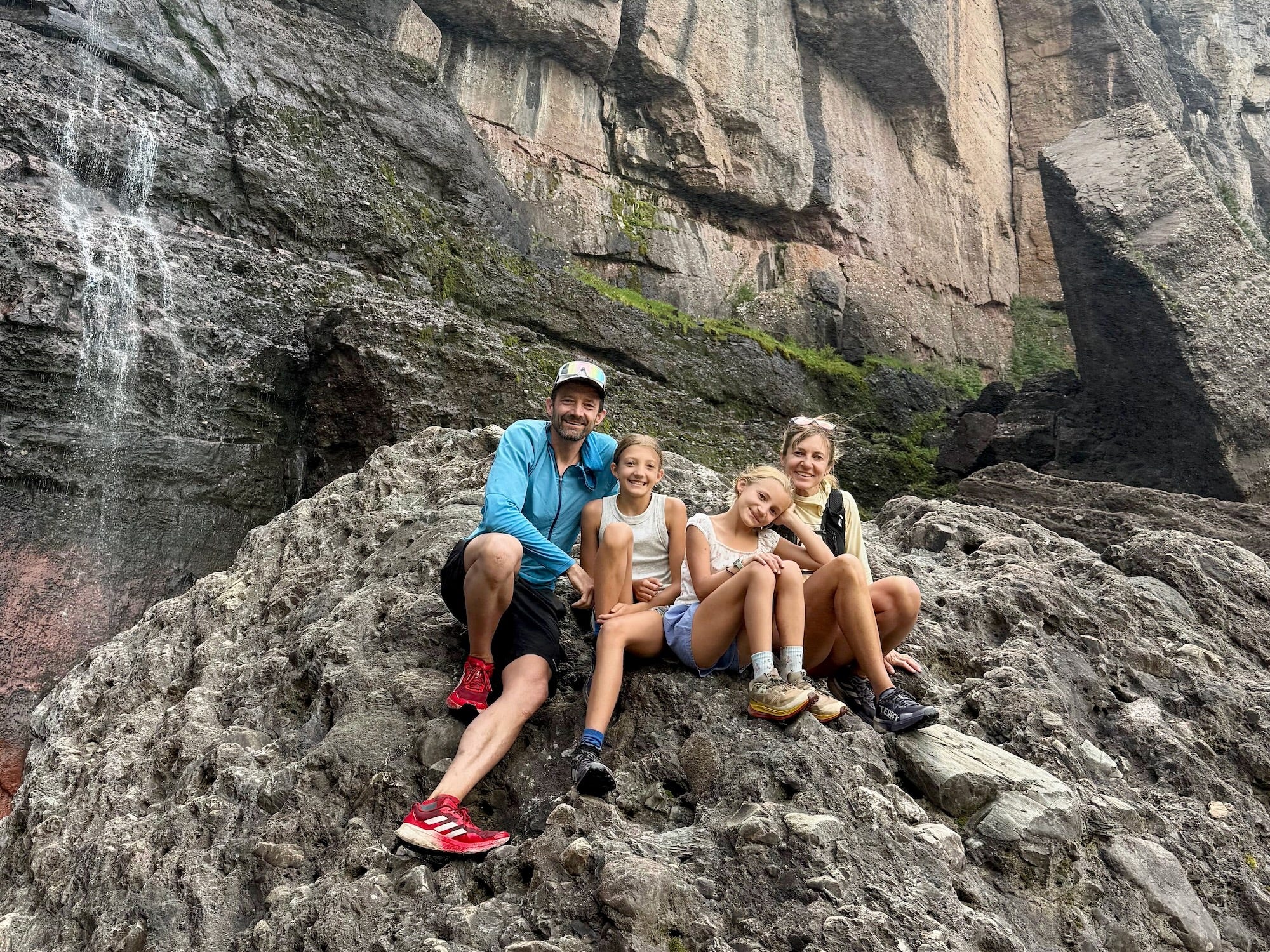
Thank you, Jared, for taking the time to talk to me—and to inspire us all.
How to get your head and heart around Hardrock
If you’re a new subscriber, you may wonder why I’m writing about Hardrock for two weeks in a row. You may not even know what Hardrock is. Dear reader, I am obsessed with the storied 100-mile mountain run in the San Juan Mountains near my home.
Readers who followed earlier iterations of my blog have had to suffer through fifteen years of me romanticizing Hardrock, ever since my first Hardrock pacing gig in 2011. I am not going to explain my love for it here. If you want to know why Hardrock is such a big deal and so meaningful to me, read this story I wrote last year about what it’s all about, followed by my report of finishing the damn thing after 46 hours that turned me inside-out.
I also invite you to watch this video I made, following a talk I gave, about the history of the Hardrock route:
I also recommend this doc by Jeff Pelletier that shows the visually stunning route:
For this year’s event, you can go to iRunFar’s preview for an overview of the top competitors.
I’ll be offline for at least 24 hours while setting up and working the remote hike-in Engineer Aid Station, at the halfway point, Friday though Saturday midday, so I won’t be able to watch the livestream. Instead, I’ll get to see the runners up close as they come through and I serve them!
I’ll be back next week with some thoughts on how it all unfolded. (Yes, that means I’ll write about it for three weeks in a row, sorry not sorry.) Fingers crossed now that it will unfold in a safe and healthy way for all!
I’ll leave you with some photos and video clips that show the weather extremes and shifting air quality here during the past week:


Hot temps and smoke-filled sky late on Saturday, July 4:
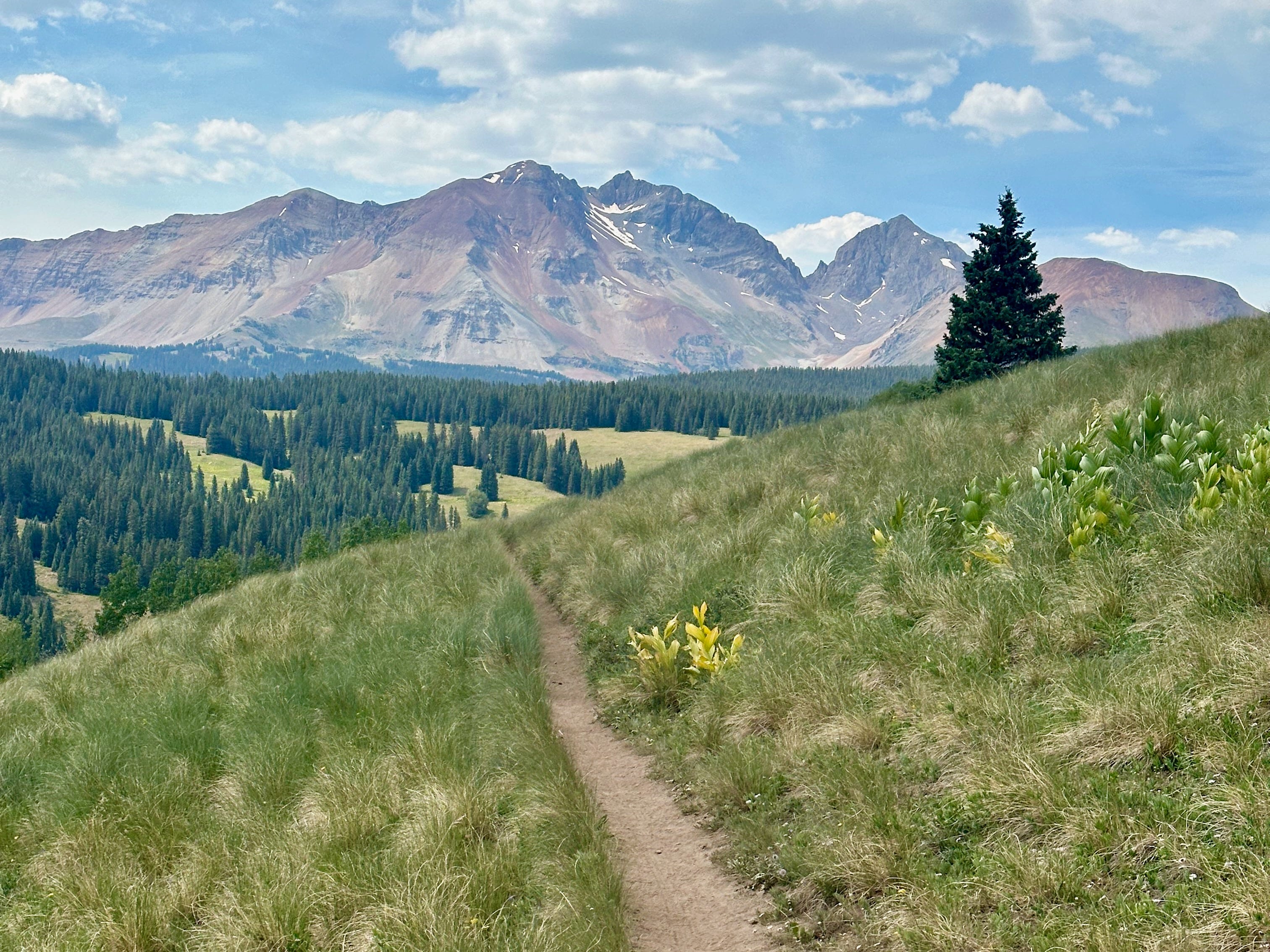
Finally, the wonderful but too-brief rain yesterday! I heard someone in a store say, “Something weird is happening outside. Water is falling from the sky.”
Jared and family are next level. This isn't "how many gels can you eat in an hour"; it's about all-around athleticism, adventure, family, environmentalism in action, friendships, career. Thank you for highlighting a person who is inspirational holistically.
I loved reading your interview with Jared! He’s got to be one of the all-time good guys in our ultra community for his vision, stewardship, and commitment to making the planet a healthier and better place — not to mention being an incredibly talented mountain athlete. And he’s obviously a supportive partner and father, as well as a role model for us all. His thoughtful nod to Jasmin Paris as they started the fifth loop of Barkley together ranks up there on the list of incredible acts of sportsmanship. Thank you for sharing it with us!