
I know many of you are here for running-related content, but this week I’m not writing about running specifically. Instead, I’m spotlighting a book and a podcast that overlap in how they scrutinize and debunk wellness claims and products. For a story about a fun run and a great runner, please go back to last week’s post if you missed it!
Quick note before this week’s main story: If you’re a woman who desires to run around the San Juan Mountains and taste part of the Hardrock Hundred course, the North Face/Hardrock Hundred Women’s Running Weekend is for you, and it’s coming up September 5 - 7. I participated in this gathering in 2023 and loved it. And it’s free, although you have to pay for travel and lodging. It’s a supportive, fun, and relatively affordable way to spend time in Silverton and run some trails on the Hardrock route. Kudos to Hardrock and The North Face for hosting this camp to boost female participation in mountain/ultra/trail running and to get more women prepped to apply to Hardrock. Use this link to get info and to register soon.

Guys, the book I’m reviewing is aimed mostly at women, but I hope you’ll read on, because men increasingly are targeted by the wellness industry (surely you’ve been hit by ads for the Hims online pharmacy). Male endurance athletes in particular seem susceptible to the male-oriented strain of self-improvement and performance-enhancement dubbed biohacking, which involves a great deal of monitoring personal metrics (which most of us increasingly and perhaps obsessively do, thanks to our smart watches or Oura rings). Plus, the multifaceted wellness industry is playing a greater role politically and culturally with the rise of RFK and the MAHA (Make American Healthy Again) movement.
I hope the book review and the podcast recommendation that follow help all of us judge and separate genuinely useful and evidence-based products or practices from all the crazy shit pushed as “detoxifying,” “balancing,” “restorative,” “clean,” “cleansing,” “strength boosting,” “regenerative,” “all natural,” and guaranteed to make you “glow”—buzzwords that insidiously make us (especially women) feel we need to do more and buy more to fix ourselves. And fixing ourselves in the name of “self-care” usually relates to the timeless societal pressure to look younger and thinner.
“How To Be Well” (Not)
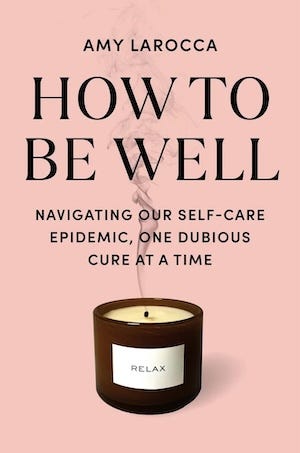
Sometimes a book comes along that feels made for the times, and I simply must read it to make sense of what’s going on around me. I had this reaction earlier in summer when I heard about the new nonfiction book “How to Be Well: Navigating Our Self-Care Epidemic, One Dubious Cure at a Time” by Amy Larocca.
I had just read a fascinating and, to me, alarming article about a Christian women’s conference that leveraged wellness influencers to appeal to women and spread an anti-feminist message. Headlined “‘Less Burnout, More Babies’: How Conservatives Are Winning Young Women” (gift link), the story shared how and why young women aspire to be “tradwifes” (prioritizing homemaking and parenting while letting their husbands be the breadwinners), and how closely the appeal is tied to wellness messages about lifestyle and nutrition by promising lower stress and more wholesome, less “toxic” living. (Ah, I thought, so this is why Murdoch’s racks are bursting with frilly prairie dresses.) The movement, attracting both ends of the political spectrum, promotes mistrust of government and established science, which feeds into choices such as homeschooling and rejecting vaccinations.
Meanwhile, from my hair salon to my Instagram feed, I’m bombarded by messages and products to look, feel, and do better. I’m generally not one to fall for trends, but I am triggered by these inputs to wonder and worry about myriad questions related to health, performance, and appearance—questions I very much doubt ever cross the mind of my husband or men like him—such as: should I make time to try the hot new Pilates studio or join the cold-plunge meetup, since so many other women I know are going there? Am I taking the right kind of magnesium? Why did my HRV drop from the 80s to the 60s last night? What’s better for my brain for creative flow and dementia prevention, daily journaling or Spanish study? What can I do about the spots on my skin near my hairline? Is my two-pound weight gain from muscle building or just temporary inflammation (and if the latter, should I take more turmeric and/or cut back dairy)? Which protein powder should I buy for my smoothies? And what is going on down there in terms of texture, appearance, and feeling—shouldn’t I do something to make it better?
To answer questions like these and, more deeply, to understand why we worry about them, I highly recommend Larocca’s book. Interestingly, it has received mixed reviews, which I attribute to the book’s poor choice of a title. If someone buys it hoping for an instructional book on “how to be well,” they’ll be disappointed. It’s not a how-to book. Rather, it’s a trenchant, nuanced, and at times snarky critique of the wellness industry and how that industry is partly an evolution and rebranding of the diet and beauty industries of my adolescence, partly a reaction to our stratified and mistrusted health care system, and partly a result of social media, stress, and superstition.
“When wellness is silly and costs a lot—cow cuddling, goat yoga, GP [Gwyneth Paltrow]’s vagina steaming, her vagina rocks, her vagina candles, not to mention her rectal ozone insufflation—it is easy to dismiss. With every stick of palo santo incense sold, the problem that good health in America has been elevated to a luxury commodity as opposed to a fundamental right is further obscured. Women are the targets of so much misleading information, so much shaming, and so many superstitions that we like to think we’ve abandoned but are now touted as progressive, helpful, even feminist. What makes the whole thing trickier is that sometimes—and only sometimes—they are these things, too.”
The best “how-to” takeaways from it, in my view, are how to think critically about whether something actually is good and necessary for you, and how to feel better about yourself as-is. You don’t have to spend so much time and money striving to get back to a better, younger, slimmer version of yourself, be it pre-baby or pre-menopause (or for us slower midlife runners, pre-slowdown).
I also appreciate that she doesn’t throw out all the good with the phony or inflated claims. Instead, she shows how “wellness” is complex and complicated, often motivated by profit and fear-based rather than evidence-based. “There is no question that some aspects of the wellness movement have the benefit of enabling new groups of people to be legitimized and heard in their complaints,” she writes. “Also, there are the seeds of new options for treatment that consider the many mysteries and vicissitudes of the human condition. In this arena, one hopes … that progress is not derailed by profit motives and greed.”
Larocca starts with an overview of the history of male-centric medicine and the rise of alternative and holistic medicine in response, which led to the marketing and profitability of products and methods deemed preventative and curing. She also examines the evolution and mainstreaming of the terms “wellness” and “self-care”—terms that certainly weren’t part of my parents’ vocabulary. (My parents used to dismiss any alternative therapies or natural food as “New Age-y” and “hippie shit,” and my mom used to roll her eyes and mutter “la-dee-fucking-dah” at the affluent women from LA who visited our hometown of Ojai for treatments at the famous Oaks Spa, expressing disdain for that which seemed exclusive and unnecessary.)
Larocca shows the ways in which, over the past decade-plus, influencers made grander promises and promoted kookier “treatments” in the name of “self-care” or “detoxing.” To give just one of numerous examples—one that seems relatively harmless, unlike the potentially perforating colonics (“enemas on steroids”) that persist in popularity—she looks at the curious case of apple cider vinegar, or ACV. It had been promoted in the early 20th century by a wellness pioneer “who, it turns out, is a liar nearly on the scale of George Santos.” Through a strange turn of events, Katy Perry and her partner bought the company that had marketed ACV. Now, despite a lack of credible scientific research connecting it to improved health, ACV is touted for everything from immune system support to better blood sugar management, and may be (note the “may”) beneficial for depression and weight loss (as one website article says).
Writes Larocca, “Debunking, it seems, has no effect on the popularity of a remedy if the claims are grand enough. In fact, it can have the opposite effect; it can elevate the method or substance in question to the status of a true secret.”
The parts I found most interesting took deep dives into how “wellness is every bit as much about looking better as it is about feeling better. … The borders between wellness and beauty are now almost entirely porous, creating a space where the pursuit of medical alternatives aligns with the search for an ideal face cream and a naturally ageless face to smear it on.”
I’ve observed this convergence of health and medicine with beauty at my hair salon, where the medical esthetician who works there promotes treatments that make otherwise smart, authentic women feel they have to spend hundreds of dollars monthly to freeze their foreheads and blow up their lips, and maybe get an IV for hydration while they’re at it. (Hello, how about a glass of water?) This pic of the salon’s sandwich board lists the services:
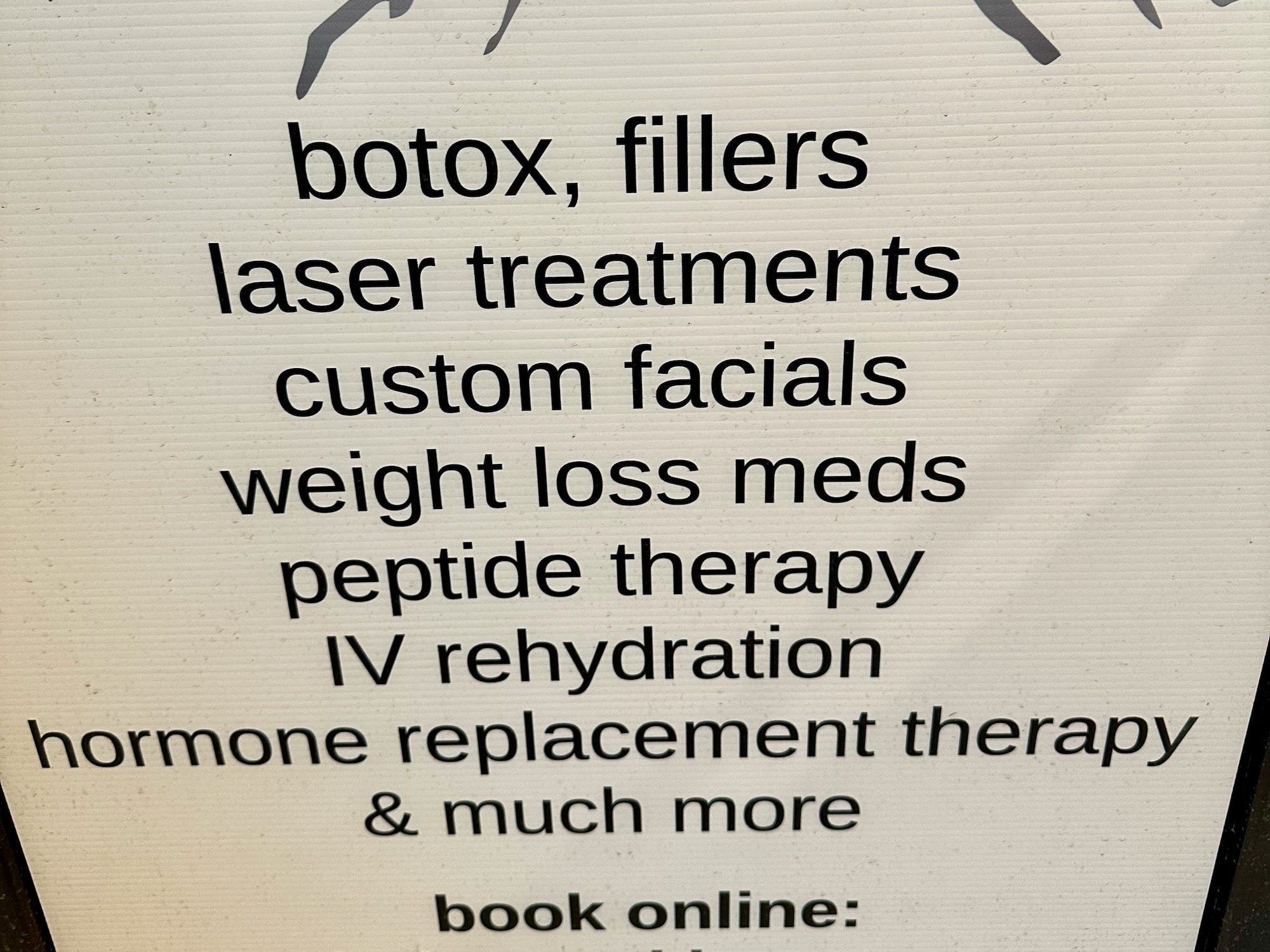
As the sign above suggests, hormone replacement therapy targeting menopausal women is now available at salons or just a click away online. I’m on HRT (estrogen and progesterone) at a carefully calibrated dose, but only after two blood tests, consultation with my gynecologist who knows my health history, and a lot of research. I wouldn’t get medicine from the same person who pushes face-peeling laser treatments or from an online doc I’ve never met and who knows virtually nothing about me.
In the pages Larocca devotes to the current marketing of menopause, she describes myriad factors that aligned during the pandemic to make women speak out more about their needs and options for menopause, and the market’s response. New research came out in mid-2022 favorable to HRT, providing an additional boost to the demand. I recall at the time, since I had just passed through “the change” and was officially post-menopausal, thinking how fortunate I am to be hitting this life phase when women are talking so openly about menopause, and I had many options for treatment.
Then, seemingly overnight, menopause was everywhere—I couldn’t escape news, conversations, or hashtags about it—and at the end of 2022, Larocca wrote a piece for the New York Times called “Welcome to the Menopause Gold Rush” (gift link) describing the startups and investment not only in menopause hormonal therapy but in products like supplements and moisturizers. Women over 50 were an untapped market no more.
In her book, Larocca describes going on Oprah’s show with other women to talk menopause and getting swept up in the good-feeling vibes. “It was so overwhelming, so optimistic, that it wasn’t until I got about ten blocks … that I realized how strange it had all been, how little this type of medical conversation leaves for the gray, for the complicated truth that many medical interventions help some people sometimes with some symptoms, but that this reality does not make for great television. Also, that aging is different from a disease and that it isn’t necessarily something to be cured.”
My salon also sports this poster promoting hormone replacement products:
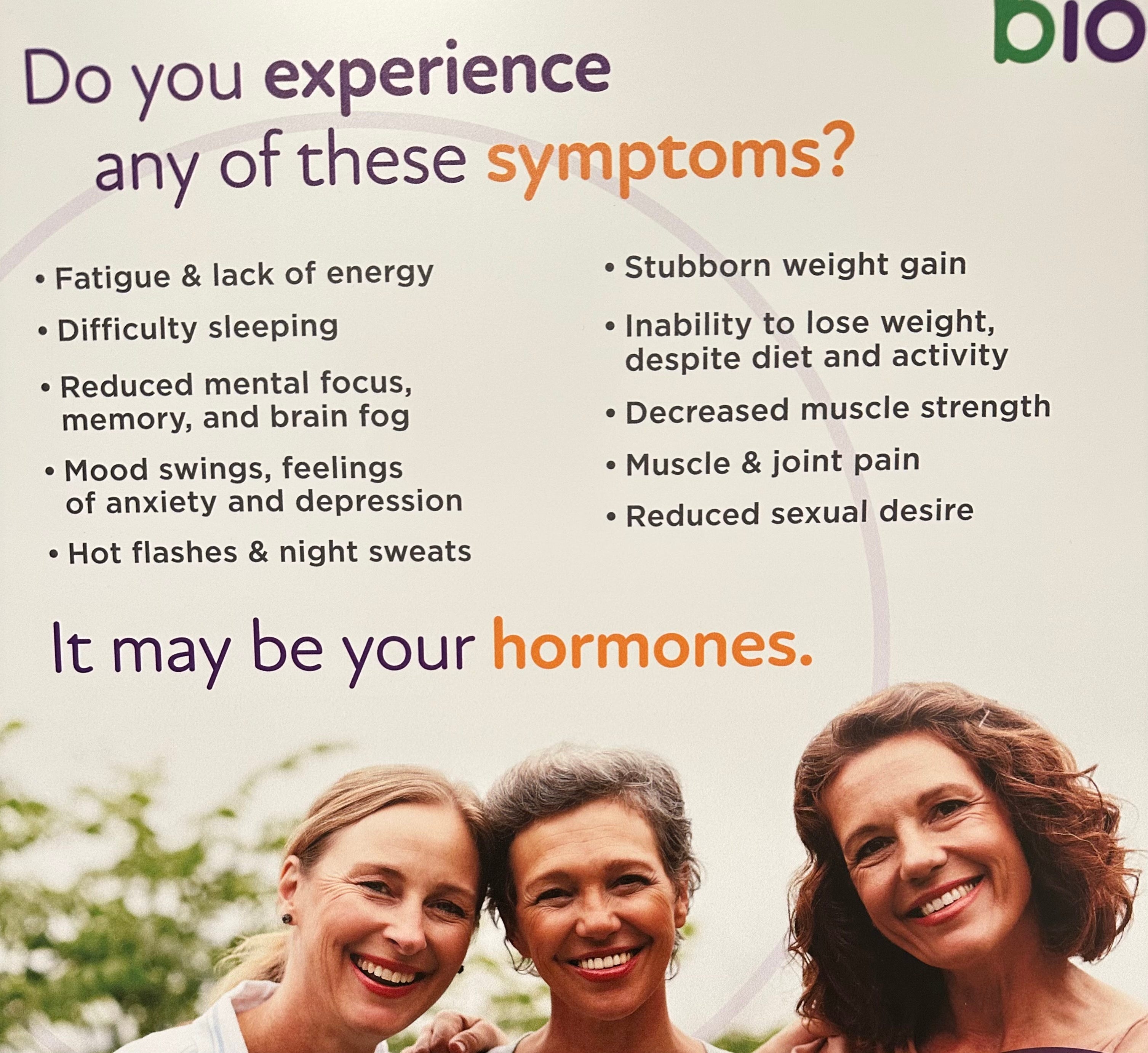
When I read the list of symptoms and the conclusion, “It may be your hormones,” it took all my self-restraint not to whip out my pen and graffiti, “Or it may be your nightly chardonnay!” I had suffered most of those symptoms on the poster’s bulleted list through my 40s, and one thing starting in perimenopause that noticeably reduced them and boosted aspects of my wellness (such as sleep, energy, and mental clarity) was kicking my half-bottle-a-night wine habit. Funny, alcohol gets a pass among midlife women, unlike so many “toxins” we supposedly need to eliminate from our bodies. And strangely, Larocca didn’t address how alcohol affects wellness. It’s a ripe topic, given the mixed messages we get about alcohol.
She addresses nearly everything else, however, and my main complaint about her book is it feels exhaustive toward the end, as if she’s trying to examine and fit everything under the wellness umbrella—from nutrition and fitness fads to spirituality (e.g. how yoga and SoulCycle became secular substitutes for religion), to lifestyle, environment, and politics.
Also, at the end, I was left feeling just plain sad when she confesses the degree to which she has obsessed about her weight and has chronically exercised indoors not for fun, sport, or adventure, but in a compulsive way to look youthful and thinner—to “glow.” She has been trapped in a privileged urban lifestyle that compels her, despite her critical thinking, to be like “the well woman” she mocks in the book’s opening. I thought, get outside, girlfriend! If ever someone needed to feel better by unplugging and hiking around the mountains, or perhaps by adopting a big goofy dog from the animal shelter—actions I’m guessing would make one feel less pressure about appearance and status masked as “wellness”—it’s her!
“An overwhelming fixation on how bodies look has marked my life and the lives of too many women I know,” she concludes, “and the enduring lesson I’ve taken from all this time in the magical world of well has to do with how easily disordered behaviors slip from health practice to unhealthy practice. … So much of what is pushed on us in the name of being healthy stinks of what we decry as its opposite. Women are forever being criticized and sold solutions, and this time is less different than we think.”
Food for thought, for sure.
Which leads me to a podcast series I can’t recommend enough.
Your Diet Sucks
I’ve linked to it before and will link here again to “Your Diet Sucks,” a podcast that has hooked me because of how it uses smart research along with humor to analyze “diet culture BS” and separate fact from nonsense. It’s produced by two women I know through ultrarunning and admire—journalist Zoë Rom and sports nutritionist/registered dietician Kylee Van Horn—and their topics overlap a lot with the topics and themes explored in Larocca’s book. However, “Your Diet Sucks” is aimed more at endurance athletes and speaks to men nearly as much as to women.
They frequently address disordered eating and other behaviors or trends that can lead health-conscious athletes down harmful or self-sabotaging paths. But they go beyond the world of endurance sports to examine the history and efficacy of trends and products more generally—everything from GLP-1 weight-loss meds to continuous glucose monitors to the MAHA movement. I’ve found the podcast super helpful to decipher the story and science behind things that pop up in our sport, such as sodium bicarb and exogenous ketones.
I’ll link to five of my favorite episodes as a starting point:
If you appreciate the podcast, I hope you’ll join me in supporting it through their Patreon.
One last plug
A Substack I admire by Josh Jackson last week spotlighted a very worthwhile nonprofit that I support, the Conservation Lands Foundation (CLF). Josh is guiding a trip with CLF to explore part of the Eastern Sierra from October 1 - 5, and it sounds amazing and informative. Please read about it in the newsletter below and support their work to protect public lands managed by the BLM.

I just realized I bookended this post with news about two mountain getaways to explore the outdoors and build relationships. Now there’s your ticket to wellness.
Agreed - great review. I have long resented and scoffed at the term "self care" as it seems inherently self centered which I believe leads to increased anxiety and neurosis. I just listened to a podcast interviewing a professor who discovered exactly that the "wellness" industry is contributing to our collective neurocis. The excessive chasing of personal happiness in the guise of "personal betterment" seems selfish. I believe an external focus - to nature, and more importantly to others - will ultimately lead to the "personal betterment" that no amount of vagina eggs can provide.
Reminds me of a line from Christine Aschwanden's Good to Go (on the "strange science of recovery"): “The fact that a whole industry has popped up to help healthy people find ways to feel anxious about their bodies seems like a statement about the weird times we’re living in.”