
Earlier this week, I wrote a bonus post for the paid subscriber group about daily habits that can set you up for an optimal day, and conversely, actions or inaction that sabotage mood and productivity. If you’d like to receive occasional bonus posts and an invitation to the monthly group chat via Zoom—and my deep gratitude—please upgrade your subscription to the supporter level. Today, I have a race report for you in the context of anxiety triggered by events out of my control. Maybe you can relate?
On Saturday, I almost didn’t race. The day broke and the race unfolded after an inauspicious night and morning that nearly made me hide in bed rather than drive an hour to the starting line.
The race was the Imogene Pass Run, a 17-mile high-altitude point-to-point mountain traverse from Ouray to Telluride that tops out at 13,114 feet and delivers about 5400 feet of climbing in the first 10 miles, from Ouray to the top of the rocky iron-streaked pass, before descending to Telluride. Started in 1974, it’s a classic footrace where top-level mountain runners mix with old-timers who have finished it multiple times over decades.
Running Imogene is a kind of rite of passage and badge of honor in the region, and one of the largest races in southwest Colorado, with some 1500 registrants. I had run it twice before—2009 and 2019—but most years I don’t race it because I frequently train on the old mining road that forms its route, and I’d rather sign up for less familiar mountain races on singletrack. But I felt compelled to do it again to gauge how I’m running this year, and also, because I seem to be having more fun and doing better lately at sub-ultra distances.
A runner’s time for Imogene’s 17 miles should roughly match their road marathon time, and that proved true the prior two times I ran it and finished around 3:20 and 3:40. I want to believe that I could still break four hours in the marathon (my last road marathon, in 2022, took 3:54), so I signed up for Imogene wanting to test whether I could finish sub-4.
I have an assignment to write about the Imogene Pass Run for Like the Wind Magazine, so I’ll save my main narrative with reflections on my connection to the route and its history for that story. For this post, I’d like to illustrate the challenge and reward of showing up to participate in spite of doubt and anxiety.
I had a terrible night’s sleep on Friday, and a poor week of sleep leading up to it. On Friday at bedtime, I made the mistake of reading the most-read story on the New York Times. It was a guest commentary headlined “This Is Really Bad” (gift link), and it’s a terrifying but important read that explains the imminent threat of AI going rogue and leading to our demise.
Lying in bed, fear activated my nervous system and clenched my stomach. My catastrophe-prone imagination flipped through images of the country ceasing to function—of us getting stuck and unable to travel to reach our kids if the electrical grid shuts down, if gas pumps and air travel fail to operate, the Internet goes haywire, food supply disrupted, our financial assets zeroed out—and my disturbing, exaggerated thoughts mixed with memories of 9/11 on its 25th anniversary. My mind replayed the days of the attack and its aftermath, when we collectively mourned and felt vulnerable.
I lay in bed spiraling into distress and fearing not only for our future but for our inability as a society to find common ground and solve problems. I fitfully fell asleep frightened and powerless.
At around 3 a.m., a blasting wind woke me when it shook our house, and stress reactivated my nervous system. The wind delivered pelting rain, and soon lightning flashed, lighting up my closed eyelids. My dog, frightened by the storm, nudged my elbow for comfort. Sheets of rain pummeled the house while thunder boomed and more lightning flashed in the windows. I considered how the weather has become more extreme, and this storm—unexpected after a too-dry week—was the new norm. My mind spun around the double threats of AI and climate change.
The sudden, extreme downpour could trigger flooding and mudslides on the highway to Ouray, since flooding has happened there with each recent heavy rain. I pictured our vehicle, and the convoy of school buses transporting runners to the start, getting stuck and sliding in the debris flow.
Sleep became impossible, and my alarm was set for 4:30 anyway, so I got up a little after 4. My legs expressed fatigue while simply standing to get out of bed. I felt utterly stressed and exhausted.
I thought, there is no way I can run. I’m scared to drive to Ouray in this storm. I’m scared to encounter lightning above tree line. I’m scared about literally everything. Bravery and resilience abandoned me. I wanted to crawl back into bed, curl up in a ball, and wait for the storm to pass and sleep, or pretend to sleep, all morning. I was a wreck.
But I had that assignment for that magazine—which in that moment I regretted pitching and getting—and a photographer to meet there, so I couldn’t flake on the commitment. I would feel like an idiot if I made an excuse about not going due to the flooding hazard and the highway turned out OK.
I moved on autopilot to execute my pre-race routine. My generous husband drove me in predawn darkness to Ouray through rain, so I wouldn’t have to leave earlier to get the shuttle bus, and mud indeed covered the roadway, but it was passable. We reached Ouray’s familiar main street at dawn, and I viewed hundreds of runners against the backdrop of the town’s historic buildings and towering mountains.
Something in me softened, and tension eased. A feeling of calm reassured my body that I was lucky to start the day in Ouray, because I always love to visit and run there, as described in this earlier post about the town, its history, and running and other adventures there:

Viewing the crowd of runners congregating on main street, with nobody seeming to mind the rain, I thought—in contrast to the “This Is Really Bad” headline—This is really good.
Another article in the Times last week, called “Spend All Your Disposable Income on Events That Make You Feel Alive,” came to mind. The writer extolled the benefit of live events like concerts that bring people together to share an uplifting experience. The emotion generated at the event has been called “collective effervescence” because, “When you’re surrounded by people experiencing the exact same emotion as you … the feeling multiplies, refracts, comes back to you heightened.” We runners experience this joy—or shared struggle—at races.
The rain continued to fall enough that I put a cheep plastic poncho over my rain jacket to stay dry and warm as we waited for the start, but I could see the clouds breaking above the mountains. Optimism rekindled as I told myself the conditions will get better, not worse.
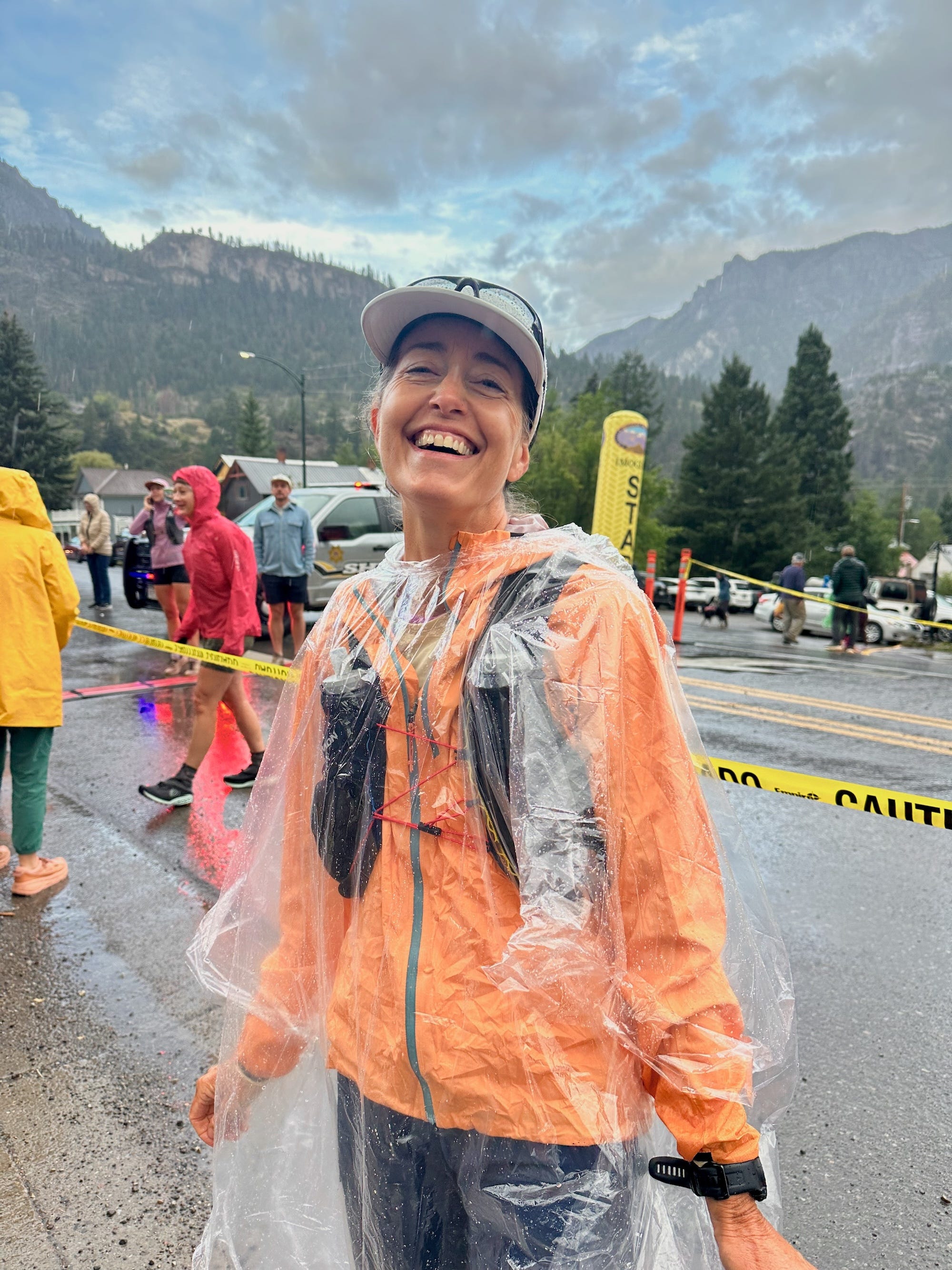
I wasn’t stressed about racing, quite the opposite. I wanted to run to distance myself from the feelings that had haunted me in the middle of the night. I wanted to run to celebrate the tradition of this race and the place.
Getting to the start line had been the hard part, and running was the easy part, the reward. This is easy, I thought, thinking of how I’d finish in about four hours, a tiny fraction of the 46 hours it took me to complete the 2025 Hardrock Hundred, which overlaps with the first part of Imogene’s route. This is good.
This is easy, this is good became my mantra for the run.
We took off and merged with Camp Bird Road, a hard-packed dirt road that becomes rocky as it ascends to the now-closed Camp Bird Mine and reaches the alpine basin named Imogene (from which Imogene Pass gets its name), after the wife of a 19th-century prospector. My legs loosened and settled into a sustainable pace, and I reveled in running around puddles, over damp earth, after a summer of dryness.
As always on this road, I pictured my grandfather, who rode horseback through snow and avalanche risk on a minus-one-degree morning in the winter of 1932 to report to work at Camp Bird Mine, where he labored for a season in danger and damp darkness underground. His story lives on through his memoir, One Man’s West, first published in 1943 and still in print. Camp Bird Road would seem like a superhighway to him now compared to the narrow, unstable passage it had been when he traveled it.
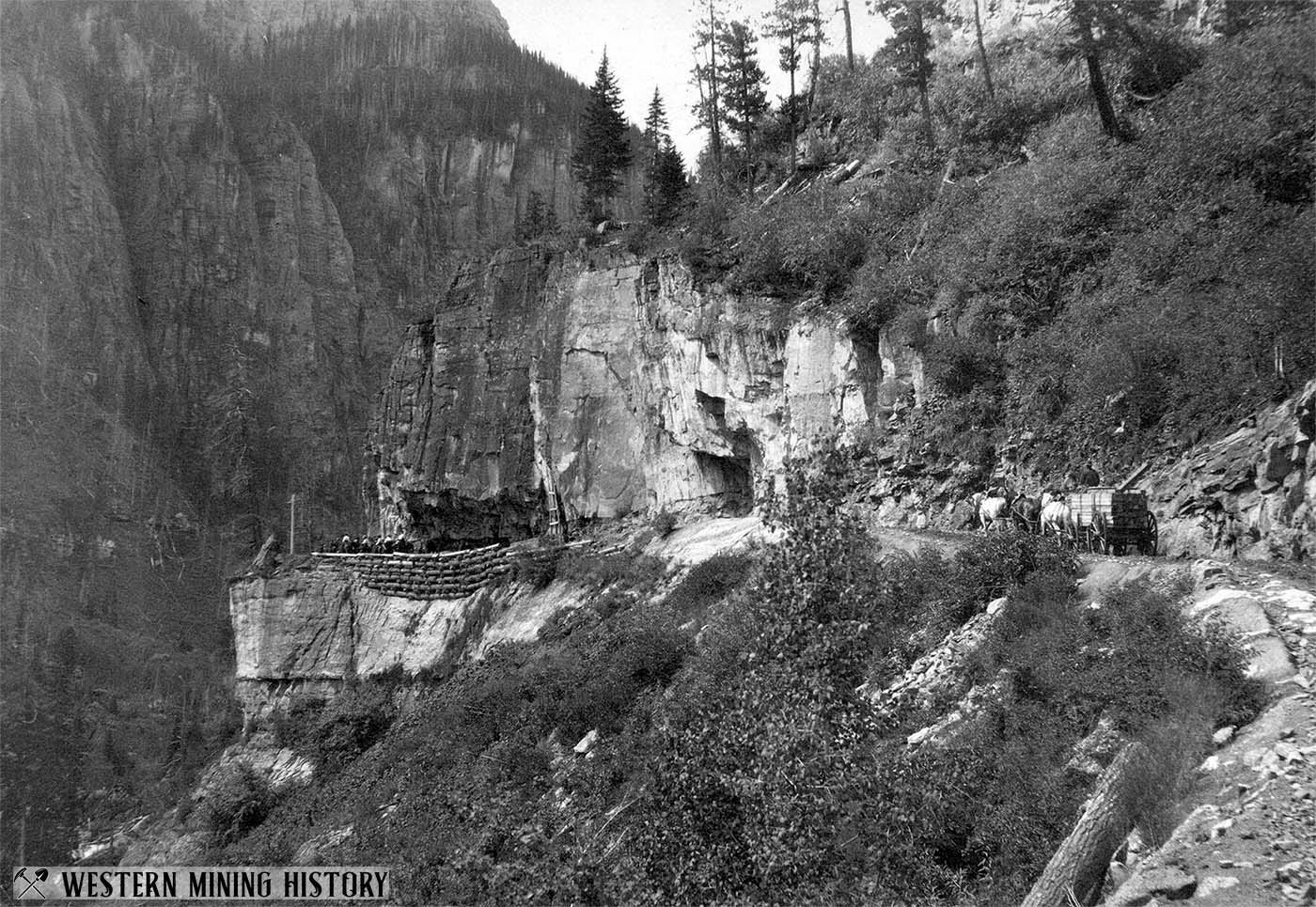


When I ran and reminisced about Grandpa this time, however, I focused less on his work in the mine and more on the context for that work, during the depth of the Depression, and his gratitude for securing a good-paying job despite its risks, given the utterly bleak and desperate prospects for work and his family’s slide toward bankruptcy.
I considered how Grandpa must have had many nights worse than I had while he was consumed with despair about the state of the country and living on the brink of poverty. Yet his love for his fiancée sustained him and stoked his determination.
My dad preserved letters between his young-adult parents from 1932, when they were engaged and my grandmother waited in New York until Grandpa could shore up his finances enough for them to marry. In the letters, Grandpa—a Princeton graduate—recounts his desperate and unsuccessful attempts to make money however possible, from selling tomato sauce door to door, to working briefly as an exterminator. I re-read the letters after the race and was struck by the portrayal of hopelessness 94 years ago:
I tramped the streets today and all to no avail, he wrote to my grandmother in October of 1932. I gave up all hope yesterday when I couldn’t even get a job at the stockyards, not even cleaning out pens—hurrah for a college education! I fought off being discouraged as well as I can, but there are moments when it rushes in and completely engulfs me. I can’t talk about my problems around the house here. The folks’ problems are pressing enough without my showing my troubles. Ed figures he lost forty dollars on every head of cattle he shipped. He shipped a thousand. No, there is enough gloom stalking about without me parading my discouragement. And so instead I write to you…
Considering the extraordinarily difficult circumstances that he personally and society at large faced back then reinforced my mantra, This is easy, this is good. The life-affirming act of joining others to run for recreation—not because we had to, but because we chose to—enhanced appreciation for my safe and secure life while also reminding me of our relatively short lifespan compared to the mountains and in the context of history.
As we approached timberline and everyone hiked rather than ran the steep slope in thin air, I hiked faster than most around me and passed too many to count.
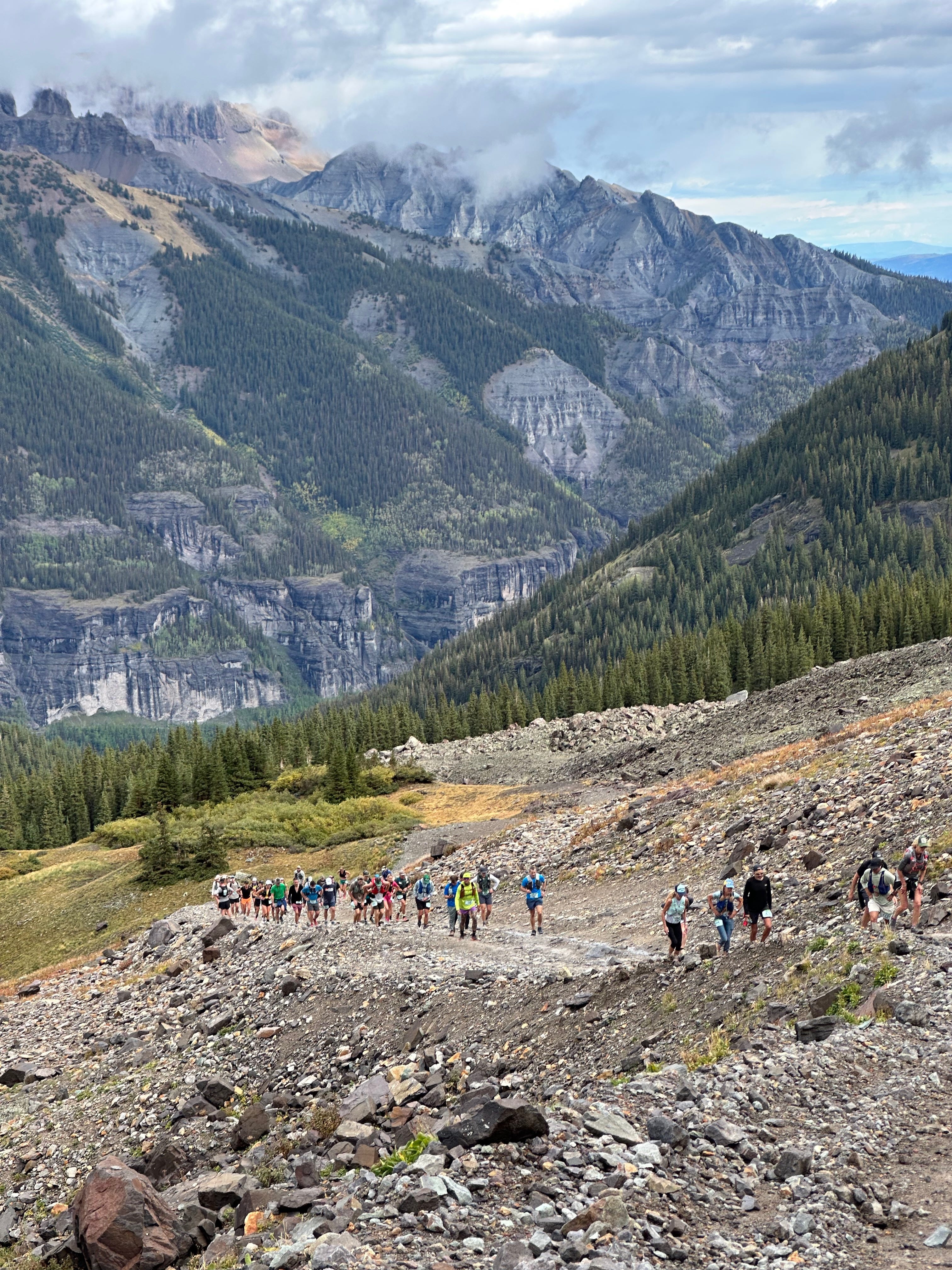
While my ability to run fast on flatter terrain has been diminishing with age, my ability to hike powerfully up steep ascents seems as strong as ever, as evidenced by performances this summer at two hill-climb races up Telluride’s ski slopes (the 2.5-mile Rundola on July 4, where I won my age group, and the 4.5-mile Telluride Mountain Run Hill Climb last month, where I finished first female). Knowing that I might get passed back by many on the downhill portion, I made the most of the uphill climb, confidence enhancing joy.
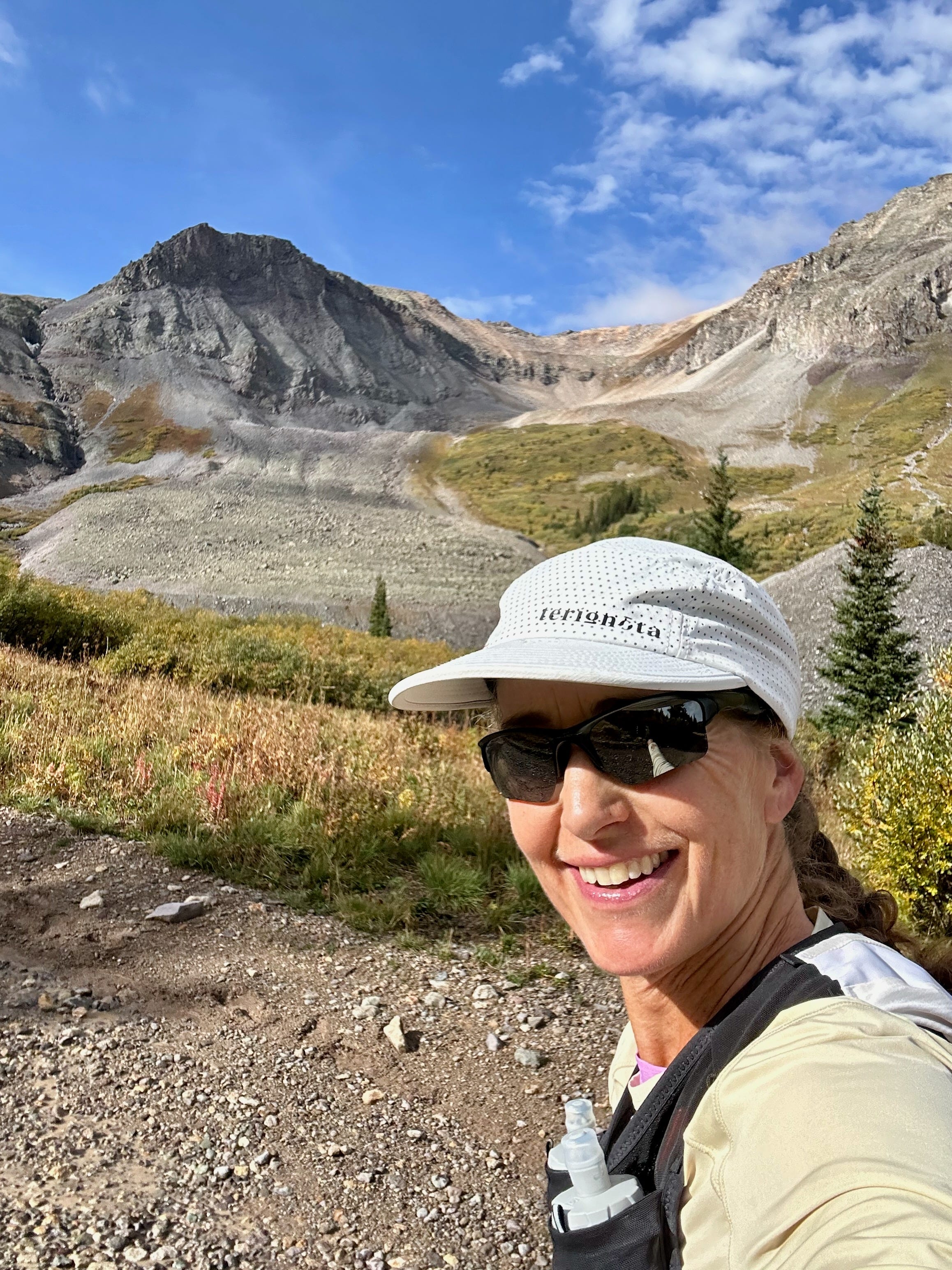
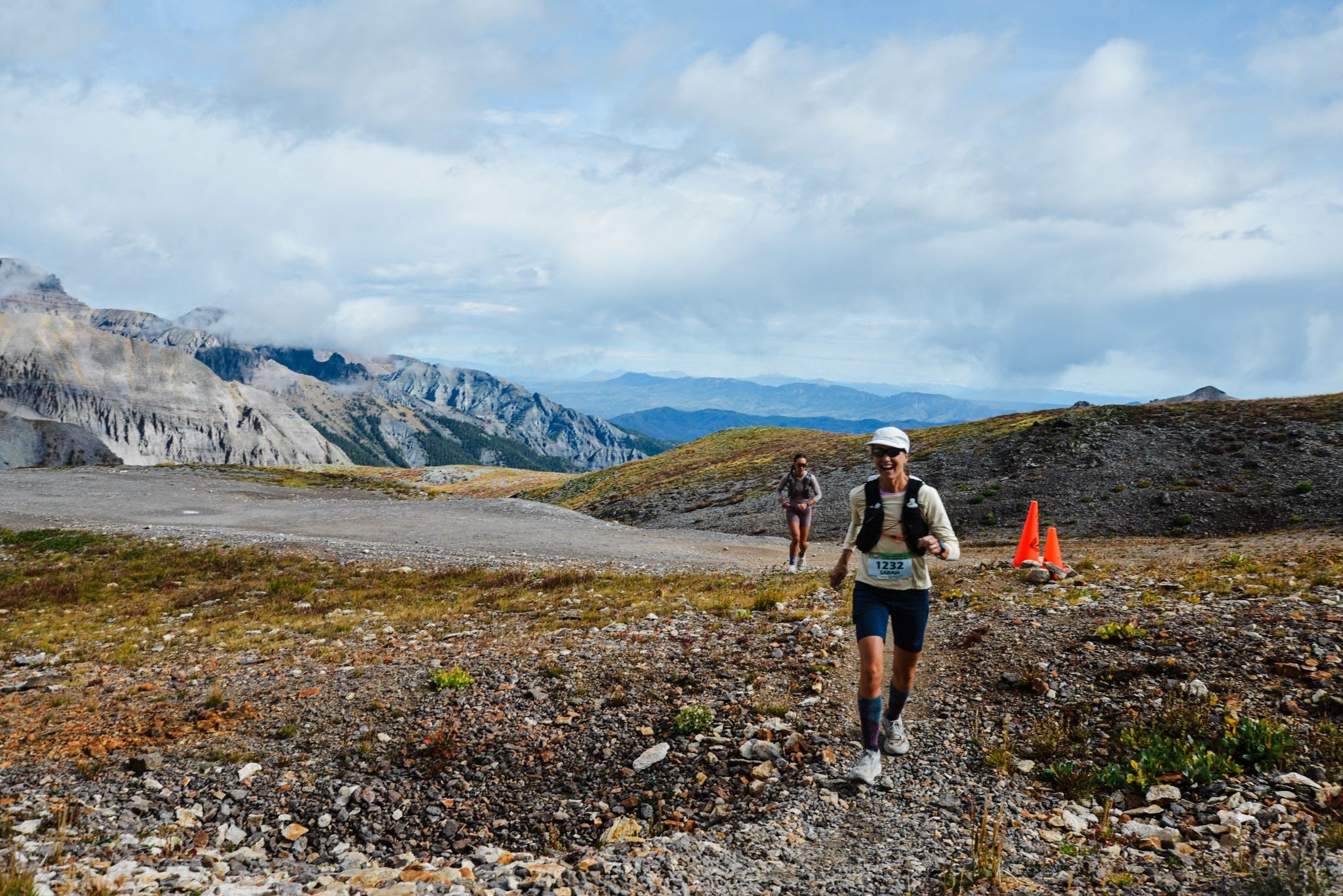
I did not take any photos on the seven-mile downhill portion from the summit to Telluride because I focused entirely on running without falling, with arms stretched like wings for balance, on a mission to finish under four hours without hurting myself. Doing the math, I knew I had to work for it.
The Telluride side of the route, through mining ruins on Tomboy Mine Road, features chunkier loose rock. The Imogene Pass Run doesn’t allow trekking poles, and I had been scared about tripping and not having poles to catch the fall. But that fear dissipated along with my other worries. I ran as fluidly and aggressively as I could, celebrating whenever I glanced at my watch and saw a pace reading in the low 9s and occasionally in the 8s.
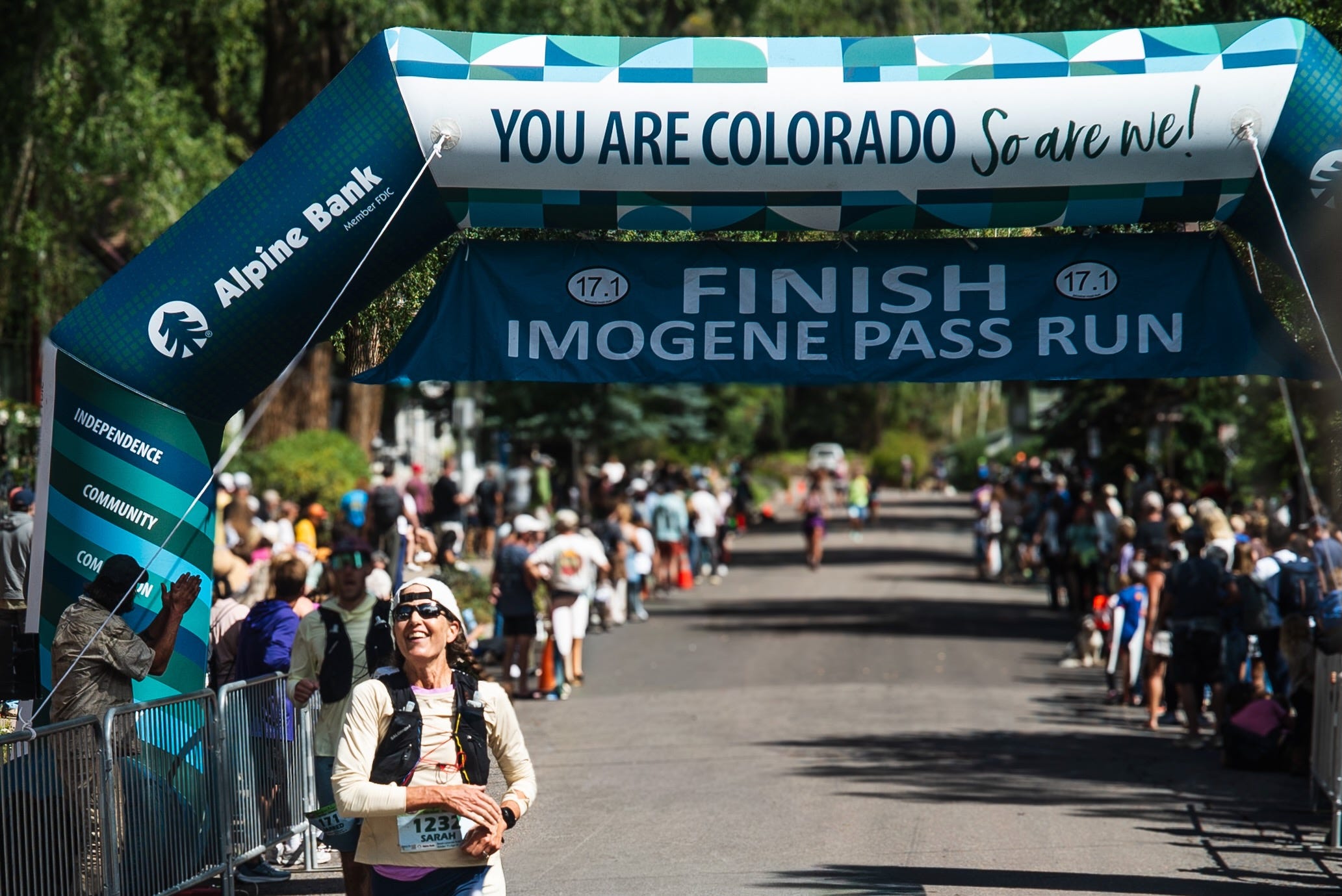
I ran the final stretch at a 7:48 pace (a sprint for me now, especially on uneven dirt terrain) and crossed in a time of 3:52, in the top quarter of the 1100+ finishers. Turns out, I was the top finisher in the women’s 55 - 59 age group out of 28 in our division. At the awards ceremony, the cheers grew louder as the age groups grew older. A local woman I know who’s 70 finished in 5:05, winning her age group, and as she stepped up to the podium and I cheered for her, I set a goal to break five hours at this race when I’m 70.
The run literally and emotionally elevated me. I had feared the worst, but the route and the movement awarded me the best. Connecting with others, reflecting on history, and traversing a mountain range shifted and enlarged my perspective and rekindled some hope for the future.
Recalling how I wanted to stay in bed while despondent, I’m reminded of the upside to showing up and starting something even or especially when your expectations are mired in pessimism and doubt. The alternative—staying stuck and powerless—is worse. Getting out to run is the best and most empowering thing I can do, so I do.
If you’d like to support my writing but would rather not commit to a paid subscription, you might consider donating a small amount to this virtual tip jar. Thank you!
Nice piece, Sarah! Brendan just shared on his Friday Inspiration!
Great job!!! I love this one . It’s really, in the end, all about the choices we make.