
If you’re new to this newsletter, welcome. I had an uptick in subscribers last week, so I want to mention to first-time readers that this post—a book review with an author interview—is a bit atypical. Sometimes I spotlight other people and write reviews, but mostly I write personal essays with advice and commentary, usually having to do with trail running and midlife. For an overview of what this newsletter is about, I invite you to read this post marking its fourth anniversary. Also, our paid subscriber group has an online meetup tomorrow. If you’d like to receive occasional bonus posts and an invitation to the monthly conversation on Zoom, please upgrade your subscription to the supporter level. Thank you for being here!
I opened The Endurance Artist, the new nonfiction book by Jared Beasley, with some trepidation, wanting to read it yet wondering if I’d actually enjoy getting to know the main character. I already knew a fair amount about the subject—the race director Gary Cantrell aka Lazarus Lake or Laz, and his two most (in)famous endurance events, the Barkley Marathons and Big’s Backyard Ultra—because I’ve followed the events online for many years and have read Cantrell’s column in Ultrarunning even longer.
Part of me wanted to absorb the behind-the-scenes details the book certainly would deliver, but the other part of me felt repelled. Laz, whom I’ve never met, struck me as creepy with his fiendish eyes, gnarled nose, and thick dirty beard. (Turns out, his nose has a horrific backstory that elicits sympathy.) Some likened him to a sadist.
I also felt skeptical of the cult of personality that had risen around him ever since the documentary film, The Barkley Marathons: The Race That Eats Its Young, came out in 2014 and made him famous.
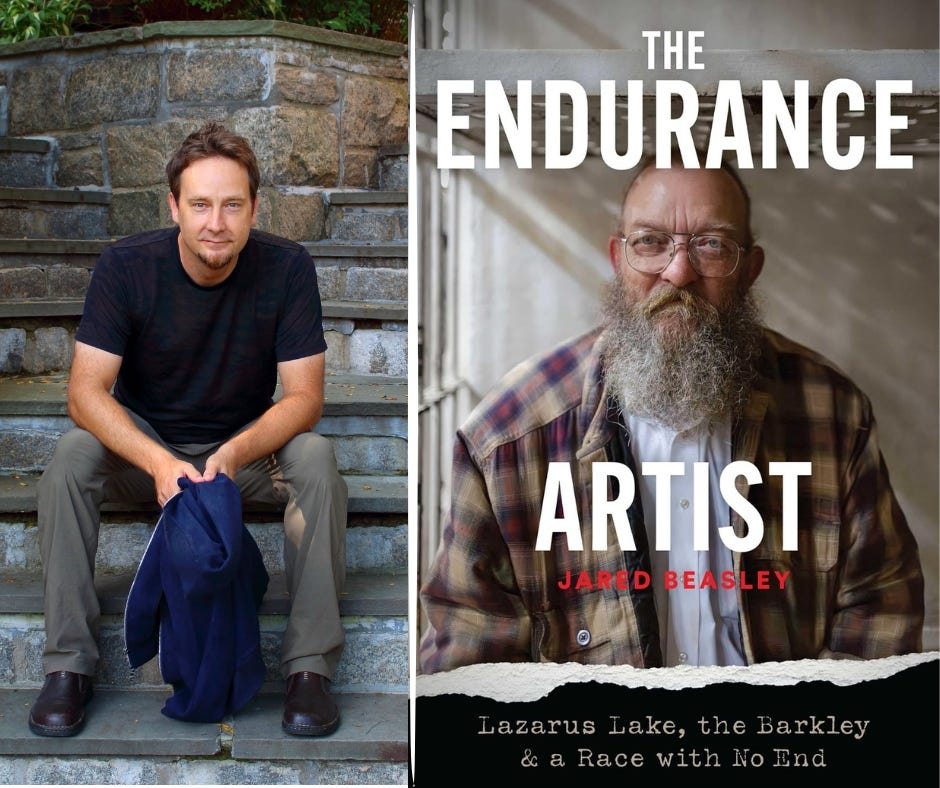
But the author intrigued me, and I wanted to get to know him. He produced an unforgettable story in the New York Times in October of 2022 (gift link) about a Ukrainian team of 15 runners competing in the international championship of the last-person-standing Backyard Ultra, one of Laz’s creations, in spite of the wartime threat of rockets flying nearby. He also, like I, writes a column in Ultrarunning, that old-school print mag (with a digital version) that’s the voice of the sport (subscribe!). But he rarely writes about himself, so he was a bit of a mystery.
I wondered, could Jared gain access to the mercurial Lazarus Lake and peel back the layers to uncover the old man’s emotions and motivations, and make sense of Laz’s complicated upbringing as Gary Cantrell? Could he unlock whatever compelled Laz to create two of the world’s most subversive and grueling ultras? Could he show a softer side to this briar patch of a person and make us feel for him?
Could he also cover the two marquee events—Barkley and Big’s—and portray the athletes testing their limits at them? Could he make the book understandable and engaging for non-runner readers without bogging down in the expository writing necessary to show how these race’s bizarre formats work? Could he make himself vulnerable by putting himself in the story? And could he answer the question at the heart of it all: what makes people quit?
Yes, he could and did—brilliantly—but it wasn’t easy. He had to jump through hoops like answering a weird math problem and running one of Laz’s backyard ultras before Laz would grant him press passes to cover the 2023 editions of Barkley and Big’s. Then he had to establish a rapport so that Laz would engage in coherent conversations rather than only utter mysterious non sequiturs, all while sitting on the sidelines and giving hands-on help to these multi-day sleep-depriving endurance events.
He spent hundreds of hours with Laz and interviewed almost everyone around him, creating a mountain of material that had to be chiseled to fit under 300 pages. On his social media, Jared called the process of getting the story and writing the book “my own private Barkley.”
(Side note for readers who so far don’t get what I’m writing about: If you’ve never heard of the Barkley Marathons or Big’s Backyard Ultra, I’m sorry, I won’t take space to explain their phenomena here. Suffice to say, only 20 people have finished Barkley’s 100-mile route in the 60-hour time limit since 1986. You can read Jared’s other New York Times article about the 2023 edition of it (gift link) for an overview on the event and Laz. To learn about the Backyard Ultra, which is a repeat-loop, last-person-standing contest, I suggest my earlier post on it. And to get a sense of the scene at Barkley, check out this post about the first female finisher in 2024 and the photographer’s perspective on it, still this newsletter’s most popular post ever.)
But really, you should buy and read the book! (The link goes to Amazon because the indies are backordered.)
Yes, I warmed up to Laz while reading about his challenged childhood and early adulthood, and especially his relationship to his dog. Jared’s writing made me visualize each scene, and his similes stuck in my head. Laz doesn’t simply turn slowly to face him, for example. He turns his head “like a robot with dying batteries.” Laz’s pinky toenail isn’t bruised and swollen, it’s “as thick as a throat lozenge.”
I also relished all the ultrarunning history told along the way, much of it gained by Jared combing through Cantrell’s column and other articles from Ultrarunning and local newspapers. Jared’s ability to re-create scenes based on research and interviews made me feel I was at one of Cantrell’s early odd races in the 1980s that broke the mold of a standard 26.2 marathon and perplexed runners who got lost or encountered mocking messages on the route. It also put me in the shoes of some of the celebrated athletes, like John Kelly or Harvey Lewis, whose stories Jared detours to tell.
Wanting to know how he endured to tell this story, I interviewed Jared Beasley over Zoom last week as he sat in his home in Scarsdale, New York, against a backdrop of framed photos of some of his running mentors and a portrait of Herman Melville.
Our conversation inspired me as a writer trying to bring my own book to life. Excerpts follow.
“Out There” and the realities of freelancing and publishing
I started by asking Jared how he found a publisher.
“I went through so many rejections, so many failures. Other writers need to know what the environment is like out there,” he said.
“‘Out There’?” I laughed, referring to how the nearly impenetrable hostile wilderness of Frozen Head State Park in Tennessee, where the Barkley takes place, is known.
“Out there is sometimes worse than ‘Out There,’” he said, describing myriad meetings and rejections he went through to find an agent and then to refine his proposal to get a publisher. Nobody wanted a straight biography about this oddball Gary Cantrell.
“If I had gotten what I wanted in the beginning—if the first agent said yes and first publisher said yes—I think I would’ve written a very boring book,” he said.
We talked about the difficulties he faced getting access to Laz—”Runner’s World was going to send me down to Barkley in 2019, and I couldn’t get a press pass from him”—and the shift he made to fully commit to the story and develop a book. That shift happened after Laz let Jared get a foot in the scene by inviting him to participate in Little Dog’s Backyard Ultra in early October of 2022.
What happened there forms Chapter 3. Jared describes himself as a “three-mile-a-day, run when the weather’s nice, feel-good runner”—not at all a hardcore ultrarunner. He struggled and tripped through only a few loops and then gave up, an experience that left him ashamed as an inner voice taunted, Why’d you quit?
“I was really beating myself up, as a runner and writer, probably overly flogging myself for doing things half-assed,” he told me. “When you’re freelancing, you’re always in a hurry, always have to send it out before it’s ready. And there’s something about Laz that makes you not feel good about doing things half-assed.”
When Laz gave him a link to cover the world championship two weeks after his poor performance at Little’s—which is how Jared got the Ukraine team’s story for the New York Times—and then Laz gave him passes to be at Barkley and Big’s in 2023, Jared was all in.
I pointed out how ambitious the book is, trying to do so many things: it’s a biography of the toughest nut to crack; it’s the coverage of two baffling running events that are more about attrition and mental tenacity than speed, and the incredible athletes who do them; it’s a window to the sport’s history; and, it’s his own story of getting the story. How did he organize it all?
“The whole thing was impossible. I did begin with an idea of a simple biography of Lazarus Lake, born in San Marcos, Texas, 1954, and then this happened, and then this happened. But nobody wanted that book,” he said. “I was unsure how to go forward at many points. I was getting all this good stuff from Laz, and it started to flow—we began talking on a daily basis, two to three hours at a pop—and I was getting almost an overload of information.” So he began devouring others’ works of narrative nonfiction and rethinking how to craft and sequence the scenes and how to put himself in the story.
I asked, given the difficulty of writing the piece, did he ever consider DNFing the book project?
“Never. I had no choice. When you burn the bridges back across the channel and all you have in front of you is the cliff, you’re going to find a way up it,” he said. As a journalist, the book became his all-or-nothing project.
“I had done five articles for the New York Times in a year, and they had just shuttered their sports desk. I had gone from getting $5000 an article at Runner’s World in 2019 when I started, to moving up the ladder, so to speak, to the New York Times to make $1000 an article, and then to the Guardian where I got $300 an article. So that’s the nature of where we are now. In fact, I just pitched an article to my editor at the Guardian to do a piece on [ultrarunner] Meg Eckert, coming into this week’s Big’s, and they turned it down because they said we just don’t have enough freelancer budget.
“I had limited my journalism to do this book. It had become so demanding that I stopped doing basically everything except my column [for Ultrarunning]. My wife was really keeping us going.”
I admitted to Jared that Laz creeped me out, based on what I knew about him through coverage of Barkley, so I had mixed feelings about reading his book. Did Jared also have an impression of him as a kind of devious madman when he started reporting?
“Of course I did,” he said. “I was initially repulsed when I saw the documentary for the first time. It wasn’t until I got around him and the people who are around him that I started to change and get a sense of what was going on, that the perception of him is very useful for the media—very sticky—and who he was and what he was doing was actually not well known, because he doesn’t talk about it. When that became apparent, then the admiration and—reverence isn’t the right word, but close to it—of the people around him started to make more sense.”
He added that some publishers had a problem with putting Laz on a book cover because of his appearance. “They said, ‘He looks homeless,’ but his appearance is not something he ever cared much about. You go to his house, and it’s a disaster; it looks like a war zone of stuff. If I pulled any punches in the book, it’s that I wanted to be a little kind in how I described his home, because he has a wife and children. But those things [like tidiness and appearance] are trivial to him. His mind is on other things—on geological formations and the history of various invasive species and all this kind of stuff, that’s literally what he’s thinking about. We very rarely actually talked about running.”
Jared said a turning point in his view of Laz, and in understanding him, came when he interviewed students whom Laz had coached at basketball and football. Laz devoted himself to the sports teams and later gave away chunks of money made from his running events to support a middle school team.
“John Kelly said it best,” Jared said, “that Laz has the personality of a rhino and heart of a golden retriever. But you don’t see the golden retriever part—you have to really go in deep, because he’s not going to tell you about it.
“And I don’t think he takes any enjoyment out of seeing people hurt. I know that sounds kind of antithetical to what he’s about, but I think he’s a bit of a purist. He wants to create a puzzle. I stopped seeing [Barkley and Big’s] as races—they’re not about who’s going to get from point A to point B the fastest—so if it’s not a race and he’s not talking to me about running, then what is all this about?”
I noted that Jared ended the book in 2023, with riveting coverage of the Big’s Backyard Ultra that October—but then two major developments happened in 2024: Jasmin Paris became the first woman to finish Barkley, and Laz embarked on a transcontinental walk, with Jared crewing him for 10 days of it. He recapped these 2024 events in the epilogue but didn’t go into them with great detail. I wondered, was it hard to end the book in 2023 when the story of Laz kept going, and is he done with Laz as a subject—or could there be a followup book?
He said that from the start, he knew the book would have a narrative arc bookended by the two events in 2023—Barkley in the spring, Big’s in the fall—with flashbacks and detours to Laz’s background. But it would have been a glaring omission, he said, not to include Jasmin’s finish or Laz’s walk, so they became the epilogue.
“I wouldn’t say I’m done with him as a topic, but I’m not going to write another book about him,” he said.
Toward the end of our talk, I said, “I’m curious how you’d describe your relationship with Laz now. Would you say you’re friends at this point, and if so, does being his friend affect your ability to report on him?”
“Good question. I don’t really know how to define our relationship,” he said. “I don’t know if I could say that we’re friends.
“When you read the book, you see some kind of relationship develop. In the beginning, we have years of ignoring emails, cryptic messages, taunting. Then you get entrance into this world, then you get insights. And gifts. When a person opens up sensitive parts of their life to you, it’s always a gift. … I think there’s a certain coach-player relationship that developed between us. What I went through is not unlike runners in the Barkley or some of the other races of finding your way in—breaking your way in—and then discovering it’s different than you thought it would be. He’s different than you thought he would be. And then, you’re being relied upon or trusted with certain sensitive things. In that respect, I came to see Laz really as a liminal being, a sort of gate guardian.
“Buddhist temples in the East usually have two ferocious-looking demonic creatures that guard the entranceway. They are meant to frighten you from the nirvana that’s in the middle, so you have to be brave enough to go past them. But once you get past them and into that space, you look back at them and don’t see them as scary creatures trying to keep you out; they’re these glorious guardians protecting you and keeping you in. So I think there’s an element to him like that.”
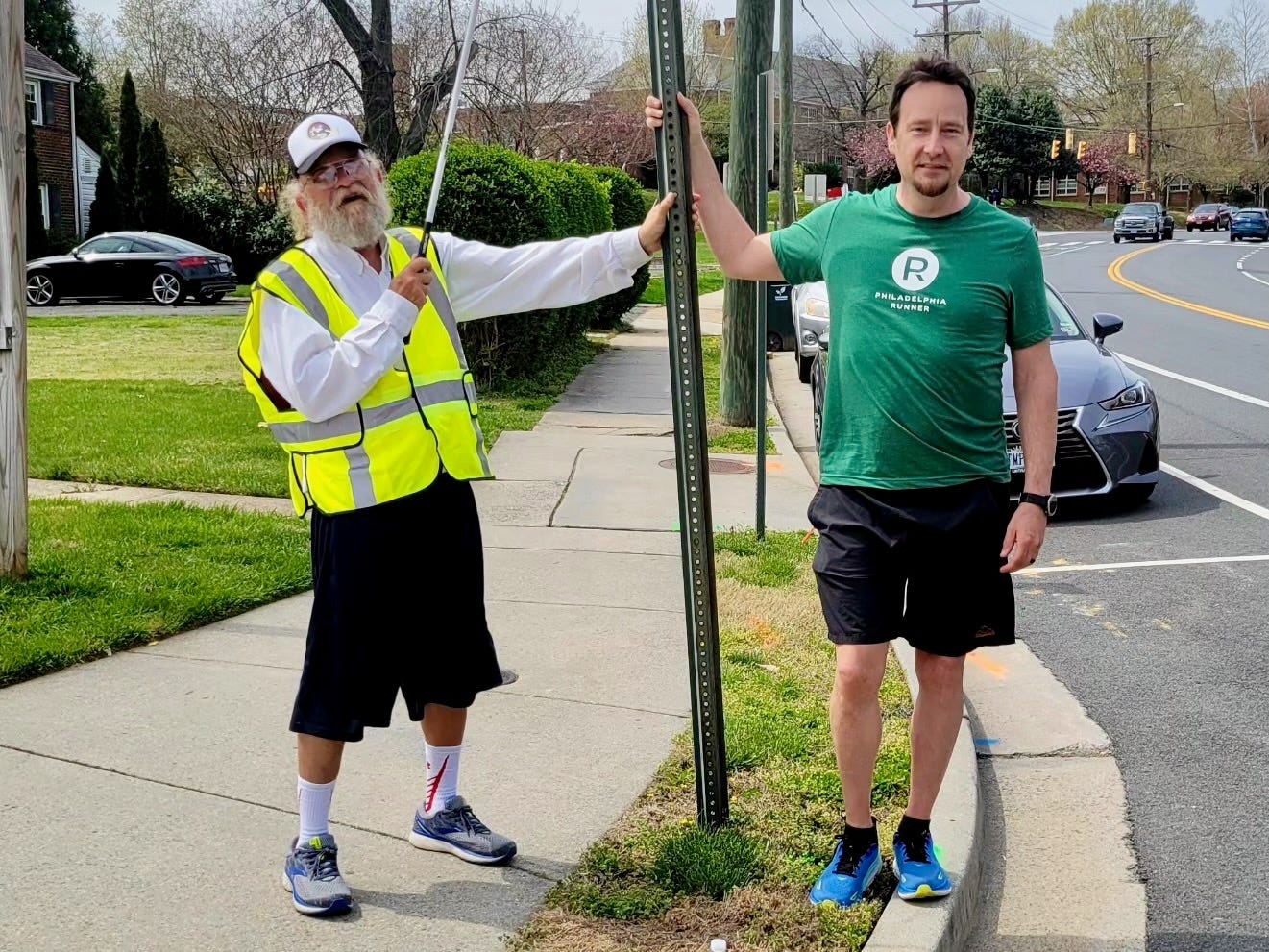
We ended talking about Jared’s background as a runner and what motivates him to run, which I’ll save for a bonus post to paid subscribers. Many thanks to the author for our conversation, which felt to me like a kick in the pants to keep writing and running.
Recently, Craig Lewis - Running Tales interviewed me for his podcast. If you’d like to hear about Hardrock and more of my running background, here’s the episode (you also can find the audio-only version on Apple or Spotify by searching for Running Tales).
I’ll end with three shots of autumn’s last phase–fall’s falling—and the beauty I saw on a rainy trail run last Sunday.


I met Laz in 2022 when I was 6 hrs from the cut off of Volstate 500. I was on a journey to find out about my limits and ended up learning about the depths of my soul. I stood around a campfire just after midnight waiting for the remaining runners and briefly chatted with him (and yes, he's a quirky, wildly weird dude who looks like he should be half dead) and realized that my feelings and how the journey impacted my very being was exactly what he had in mind.
I already bought the book, but still haven't cracked it open. This post made me very excited to do so!